Avicenna J Environ Health Eng. 12(2):128-145.
doi: 10.34172/ajehe.5491
Review Article
A Review of the Biological Decolorization of Synthetic Azo Dye From Textile Wastewater by Bacterial Strains
Zahra Emadi Conceptualization, Formal analysis, Investigation, Validation, Writing – original draft, 1, 2 
Mehraban Sadeghi Conceptualization, Data curation, Methodology, Project administration, Resources, Supervision, Validation, Writing – review & editing, 2, *
Solieman Forouzandeh Investigation, Software, Visualization, Writing – review & editing, 2
Author information:
1Student Research Committee, Shahrekord University of Medical Sciences, Shahrekord, Iran
2Department of Environmental Health Engineering, School of Health, Shahrekord University of Medical Sciences, Shahrekord, Iran
Abstract
Artificial dyes are regarded as one of the most problematic environmental pollutants. They are widely applied in the textile, print, paper, paint, pharmaceutical, food, cosmetics, and leather industries. The textile industry produces large volumes of colored wastewater, along with other pollutants such as salts, toxic substances (e.g., heavy metals, biocides, and oxidizing agents), high organic load, nutrients, and sulfur. These dyes adversely affect living organisms and ecosystems by inhibiting photosynthesis and causing health disorders such as skin irritations, allergies, cancer, vomiting, and weakened immune reactions. Thus, they should be removed using physical, chemical, and biological methods. Chemical and physical methods need regeneration processes and chemical agents, and they are expensive. In contrast, bio-decolorization by bacteria, fungi, algae, and plants is an environmentally friendly and cost-effective technique. Bacterial strains can adsorb, degrade, and flocculate dyes. Biodecolorization is positively or negatively affected by operational parameters such as agitation, pH, temperature, dye concentration, carbon and nitrogen sources, salinity, electron donors, and redox mediators. As stated, these parameters have positive (optimum concentration) and negative (beyond optimum) impacts on decolorization efficiency.
Keywords: Synthetic azo dyes, Textile industry, Bio-decolorization, Bacterial strains, Operational parameters
Copyright and License Information
© 2025 The Author(s); Published by Hamadan University of Medical Sciences.
This is an open-access article distributed under the terms of the Creative Commons Attribution License (
https://creativecommons.org/licenses/by/4.0), which permits unrestricted use, distribution, and reproduction in any medium, provided the original work is properly cited.
Please cite this article as follows: Emadi Z, Sadeghi M, Forouzandeh S. A review of the biological decolorization of synthetic azo dye from textile wastewater by bacterial strains. Avicenna J Environ Health Eng. 2025;12(2):128-145. doi:10.34172/ajehe.5491
1. Introduction
Dyes and colorants are inseparable substances of human life. They are ubiquitous and play vital aesthetic and functional roles (1). The earliest evidence of the application of colored substances by humans dates back to 15000-9000 BC, as seen in the cave paintings and drawings on the walls of the Altamira cave in Spain. Humans drew these paintings with ochre, hematite, soot, and manganese oxide (2). Today, dyes are widely applied for dying in different industries such as textiles, cosmetics, rubber, leather, and printing (3). They are typically used in aqueous solutions due to their affinity for substrates (e.g., fibers) (4). Dyes and colorants are categorized into natural and synthetic (artificial).
2. Materials and Methods
This review was carried out to assess the adverse impacts of textile industry and its treatment methods. In this review, the published manuscript were retrieved from Web of Science, PubMed, Google Scholar, and Scopus using keywords and phrases such as natural dye, synthetic dye, textile wastewater, textile and living organisms, textile and human, textile and environment, textile wastewater and decolorization, fungi and decolorization, algae and decolorization, plant and decolorization, bacteria and decolorization, dye-biosorption and bacteria, dye-degradation and bacteria, and dye-flocculation and bacteria. No time restriction was applied to the literature search.
3. Results and Discussion
3.1. Types of Dyes
Natural dyes are usually extracted from natural compounds and organisms. Vegetable dyes are extracted from bark, roots, wood, and leaves of plants. In addition, some natural dyes are extracted from lichens (Rocella tinctoria: Cudbear dye) and fungi (Sarcodon squamosus: blue, Hydnellum geogenium: green, and Hypholoma fasciculare: yellow) (4). Red colorants are derived from plants such as Sorghum bicolor and from insects, while black dyes are derived from tannin-rich plants such as harda and logwood (5). The first synthetic dye was accidentally discovered by William Henry Perkin in 1856 (Mauveine: a cationic dye) (6). Organic synthetic dyes are composed of three main components: the chromophore, chromogen, and auxochrome (Fig. 1). Chromogens are aromatic compounds such as naphthalene, benzene, and anthracene (7). The chromophore is responsible for generating color and contains groups such as azo, nitro, anthraquinone, methine, phthalocyanine, triarylmethane (triphenylmethane), and indigo (8). Auxochromes influence the intensity of color, enhance solubility, and improve the adhesion of dyes to the fibers. They include carboxyl, methylamino, sulfonic, dimethylamino, amine, alkoxyl, hydroxyl, and electron-donating groups substituents (-NO2 / -CO2H / -SO3H / (-OCH3)Cl or I or Br or At) (9,10).
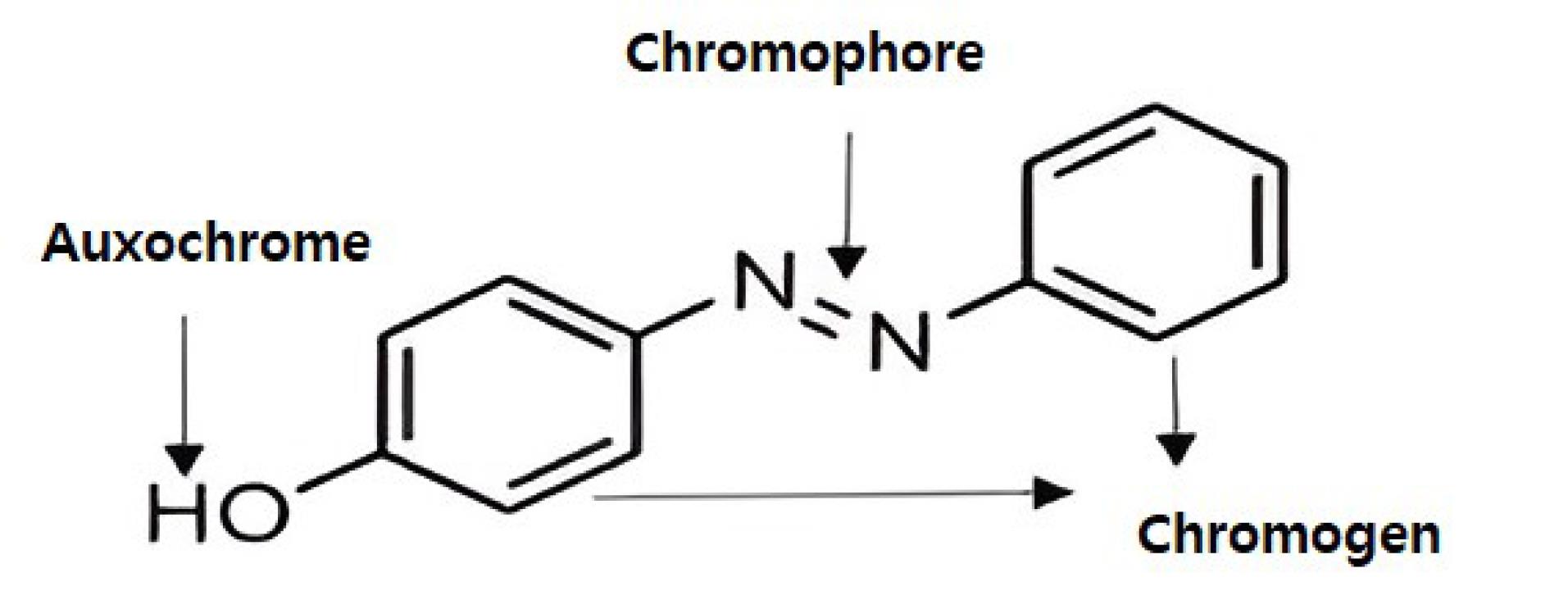
Fig. 1.
The Component of Solvent Yellow-7 (or 4-Hydroxyazobenzene) (8)
.
The Component of Solvent Yellow-7 (or 4-Hydroxyazobenzene) (8)
3.2. Classification of Synthetic Dyes
Approximately 10,000 commercial artificial dyes are utilized across various industries, including cosmetics, textiles, plastics, food, ink, leather, pharmaceuticals, paper, paint, and photography (11). Easy production and high resistance to heat, detergents, and sunlight are the main properties that make synthetic dyes more applicable compared to natural dyes (8,12,13). As presented in Fig. 2, synthetic dyes are categorized based on various criteria such as application, charge, and solubility. Cationic and anionic dyes produce positive and negative charges in the aqueous solution, respectively (14).
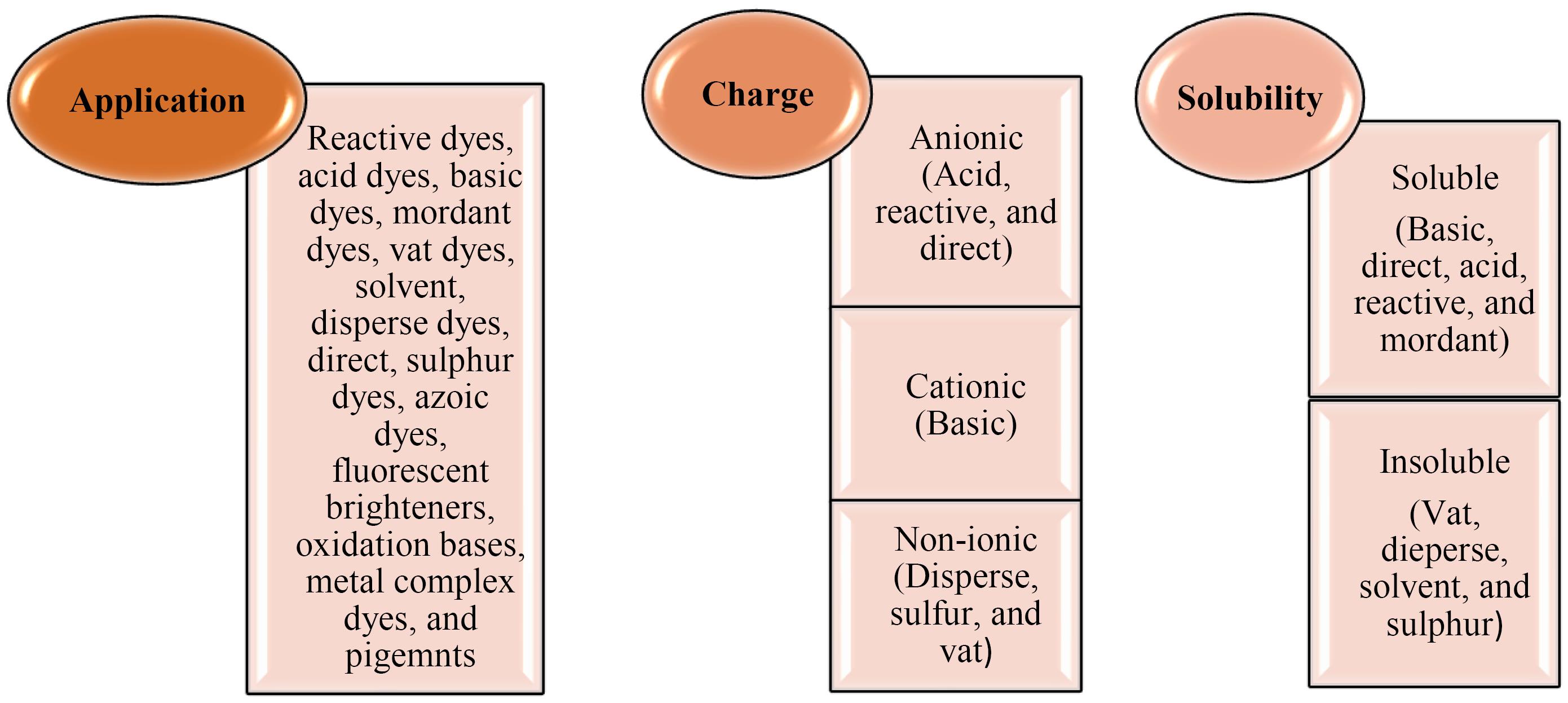
Fig. 2.
Different Categories of Dyes (7,15,16)
.
Different Categories of Dyes (7,15,16)
Azo dyes are the most popular group of synthetic colorants, accounting for about 70% of global dye production. They are generally grouped based on the number of azo bonds in their structure: mono-, dis-, tri-, tetra-, and poly-azo dyes contain one, two, three, four, and more than four azo bonds, respectively (17,18). Structurally, azo dyes comprise aromatic compounds (e.g., naphthalene and benzene) linked by azo groups (–N = N–) (19). Mono-azo dyes contain a single azo bond in three forms:
-
Benzene–N = N–heterocyclic compounds or heterocyclic–N = N–benzene, producing yellow and orange shades.
-
Benzene–N = N–naphthenic compounds, producing red and blue shades.
-
Naphthalene–N = N–naphthalene, producing black shades.
Dis-azo dyes (e.g., Matt blue, black, green, and brown) are usually derived from m-phenylenediamine and resorcinol compounds, while poly-azo dyes are used to produce dark shades of brown, red, and black (20).
3.3. Characteristics of Textile Wastewater
The textile industry plays a significant role in the global economy. Consequently, various textile factories have been developed worldwide. However, the textile industry involves various processes that generate different pollutants, as described below.
3.3.1. Pollutants in the Textile Industry
Different pollutants are generated in the textile industry.
Salts: Sodium chloride, sodium nitrate (NaNO3), and sodium sulfate are extensively used in the textile industry. It is reported that approximately 40-100 g/L of NaNO3 is applied during the dyeing process, as dyes are better fixed on the fibers in the presence of salts (21). When wastewater containing chlorine salts is discharged into the water environments, it reduces dissolved oxygen levels. Moreover, chlorine can react with other substances, producing resistant chlorine compounds.
Organic compounds: Different organic compounds, including enzymes, tallow, sizing materials, organic dyes, and organic acids, are applied in the textile processes, which can cause an increase in both biological oxygen demand (BOD) and chemical oxygen demand (COD) in wastewater (22).
pH variability: The pH of textile wastewater ranges from neutral to alkaline values, as dyeing processes with different dyes are carried out under various pH values (reactive dyes are treated under alkaline conditions) (21). In addition, the consumption of sodium hydroxide in the textile industry (e.g., mercerizing, washing, and scouring) leads to the generation of slightly alkaline wastewater (23).
Heavy metals: Heavy metals are individually applied in the dyeing process and are also present in certain structures, such as metal-complex or mordant dyes (24). These metals increase fixation and fastness of dyes on fibers (as a mordant). Chromate and dichromate salts (e.g., potassium dichromate and sodium dichromate) are the main salts for fixation in the dyeing process. Other heavy metals used in the textile industry include zinc (biocides, fixing agents, and impregnating agents), aluminum (impregnating and finishing agents), lead (mordant), copper (mordant), cadmium (biocide), and silver (biocide) are consumed in the textile industry (9). In wastewater, metals readily react with other compounds, resulting in the formation of complex metal salts (22). It should be noted that heavy metals have neurological and carcinogenic effects (25,26). Colorants and dyes are also important pollutants in textile wastewater. High temperature is considered an urgent parameter in dyeing performance. High temperature causes fiber swelling, which facilitates the penetration of dye auxiliary groups into the fiber’s internal structure and enhances dye-fiber bonding (27).
3.3.2. Effect of the Textile Industry on the Environment and Living Organisms
Pollutants in textile wastewater exert adverse and harmful impacts on the environment and living organisms. The presence of dyes in the water bodies is particularly undesirable, as they remain visible in aquatic media even at low concentrations (1 mg/L) (12,28). These conditions lead to complicated problems, which are described in detail in Table 1.
Table 1.
Adverse Effects of Textile Wastewater on the Environment and Living Organisms
|
|
Matrix
|
Effects
|
Reference
|
| Environmental effects of textile wastewater |
Water |
Deterioration of water appearance and aesthetics, blockage of light infiltration, reduction of photosynthesis and oxygen production, formation of anoxic conditions, influence on microbial population and activity, increased turbidity of aquatic media due to suspended collidals in textile wastewater, production of low-quality water unsuitable for agriculture and human use due to salt discharge, influence on aquatic life due to pH alteration, and accumulation of heavy metals |
(12,29,30) |
| Soil and plants |
Changes in productivity, fertility, and nutrient supply of plants due to surfactants in textile wastewater, changes in plant sensitivity to various pathogens, and detrimental impacts on chlorophyll content |
(31,32) |
| Health effects of textile wastewater |
Human |
Abortion, hives, asthma, anaphylactic shock, reduced immune reactions, hyperactivity disorder in children, decreased intelligence quotient (IQ) in children, altered T3 and T4 generation, vitamin B6 deficiency, mitochondrial respiration issues, idiosyncratic behaviors, renal and hepatic disorders, brain and nervous system disorders, reduced lymphocyte and white blood cell → Synthetic colorants
Respiratory problems, skin sensitivity and irritation, asthma, and nasal mucous membrane inflammation (rhinitis) in employees → Reactive dyes.
Vomiting, altered heart rate, quadriplegic disorders, cyanosis, jaundice, and tissue necrosis → Cationic dyes.
Mutagenic effects, allergies, and skin irritation → Basic dyes. |
(6,28,29,33) |
3.4. Decolorization of Synthetic Dyes
Given the deleterious effects of textile wastewater containing dyes, it is essential to treat these effluents before their discharge into the environment. The aromatic structure and synthetic origins of artificial dyes make their decolorization process complicated. Various biological, chemical, and physical techniques have been applied for dye removal, each with its advantages and disadvantages (Table 2).
Table 2.
Different Chemical and Physical Methods for the Decolorization Process (
10,
20,
33,
39-
59)
|
Methods
|
|
Advantages
|
Disadvantages
|
| Ozonation (O3) |
Strong and fast oxidants react with multiple bonds in dye structure (C = C, C = N, N = N): short reaction time |
High cost, short half-life (20 minutes), instability in the presence of pH variations, salts, and temperature |
| Fenton |
Effective for a variety of dyes, relatively low cost, high COD reduction |
Requiring low pH (limiting for treatment of alkaline textile wastewater) and generating sludge |
| Photolysis |
UV/H2O2 |
Generating highly active hydroxyl radicals (2.80 V),miscible ability of H2O2 with water, commercial accessibility and stability of H2O2; low investment cost, effective decomposition of dye chromophore groups |
Sensitivity of UV + H2O2 to carbonate scavenging at high pH and to the scavenging effect of high H2O2concentration |
| UV/TiO2 |
Effective dye removal, stable under different situations, high radical production ability |
Decreasing the catalyst activity in the presence of high dye concentration |
| UV/Fenton |
Enhancing the activity of Fenton reagents through UV application, generating high-valence Fe intermediates with high capacity to attack organic compounds |
Limited pH range (2-5), similar to the Fenton process, additional cost for sludge processing |
| UV/O3 |
Decreasing the required O3 concentration through UV application, preventing bromate formation, and achieving higher removal capacity than O3 and UV alone |
Specific radiation output of UV lamp for effective photolysis of O3 |
| Electrochemical |
High efficiency in removing a variety of dyes, BOD, COD, and TSS |
High cost (high energy need), restricted electrode lifetime, uncontrolled radical reactions |
| Sodium hypochlorite |
Initiating and accelerating azo bond cleavage via Cl |
Generating aromatic amines, ineffective in removing disperse dyes |
| Sonolysis |
US/TiO2 |
Increasing the number of nucleation sites and generation of additional hydroxyl radicals, adsorbing anionic dyes at positively charged surface sites (pH < pHPZC) |
Effective only in a specific range of pH (pH < pHPZC of TiO2) |
| US/Fenton |
Simple generation of hydroxyl radicals, more efficient than individual US or Fenton treatment, improving Fe3+ to Fe2+ conversion |
Efficiency depends on the size of the iron powder or other particles in the medium (larger iron particles can scatter ultrasound waves and reduce cavitation performance) |
| US/O3 |
Synergetic effects on dye degradation, decomposing O3 in the presence of US bubbles (cavitation) and producing more hydroxyl yields |
Ineffective in the removal of high dye concentrations, scavenging effects from CO32-, SO42-, and PO43- |
| Coagulation-flocculation |
Low toxicity, high color removal ability, and simple process |
Requiring process control, producing sludge |
| Adsorption |
Activated Carbon |
Effective for removing different types of dyes |
Expensive, requiring regeneration |
| Peat |
Good efficiency due to cellular structure |
Lower specific surface area than activated carbon |
| Fly Ash and Coal |
High surface area, inexpensive |
Variable adsorption capacity depending on Al2O3, SiO2, and combusted carbon content |
| Nano Particles |
High surface area, high activity |
Agglomeration into the coarse particles reduces catalytic activity, surface area, and separation and detachment of fine nano particles after application |
| Clays |
Inexpensive, stable, high surface area, ion exchange characteristics, and broad accessibility |
Lower efficiency for removing anionic dyes due to predominantly negative surface charge |
| Membrane filtration |
MF |
Effective as a pre-treatment for NF and RO, removing solids and colloids (0.1-1 µm) |
Dye molecules can pass through due to the large pore size |
| UF |
Removing macromolecules and particles, serving as pre-treatment for RO |
Pore clogging /short lifespan |
| NF |
Purifying and separating salts and bulk textile processing wastewaters, removing hydrolyzed reactive dyes |
Requiring regular cleaning, high-performance cost, prone to fouling, high pressure |
| RO |
The best method for removing a wide variety of dyes |
Prone to fouling, generating concentrated sludge, and requiring high operating pressure |
| Ion exchange |
Regenerable |
Not effective in removing all dyes |
Note. Al2O3: aluminum oxide; BOD: Biochemical oxygen demand; CO32-: Carbonate; COD: Chemical oxygen demand; Fe3+: Ferric; Fe2+: Ferrous; H2O2: Hydrogen peroxide; MF: Microfiltration; µm: Micro meter; min: Minute; NF: Nanofiltration; PO43-: Phosphate; pHpzc: pH point of zero charge; RO: Reverse osmosis; SiO2: Silicon dioxide; SO42: Sulfate; TiO2: Titanium dioxide; TSS: Total suspended solids; UF: ultrafiltration; US: Ultrasound; UV: Ultraviolet; V: volt.
Removal of dyes by chemical techniques refers to the oxidation of these compounds. This approach is considered straightforward and transforms dyes into low-molecular-weight compounds such as nitrogen, water, carbon dioxide, sulfate, and aldehydes. The production of reactive radicals, which attack pollutants, is a key advantage of this method. Combined application of oxidants generates more radicals and higher removal efficiency compared to the use of individual oxidants. However, one of the main limitations of chemical oxidation is its high cost (33,34), which cannot be supplied in all areas and countries, especially in low-income countries.
Physical decolorization of dyes is generally implemented using membrane filtration and adsorption. Membrane techniques can effectively reduce BOD, COD, and colorants, while the adsorption process offers a simple approach. However, both methods produce secondary wastes that require additional treatment (35-37).
It should be noted that coagulation is a chemical process, whereas flocculation is a physical process, and both are most effective when applied together rather than individually. Therefore, a safe, cost-effective, and eco-friendly approach, such as bioremediation using potent microorganisms, should be applied to decolorize synthetic dyes from wastewater (38).
3.4.1. Biological Decolorization
Biological decolorization is an environmentally friendly technique that is generally less costly than other methods. In addition, dye decolorization can occur under different conditions, including aerobic, anoxic, anaerobic, and a combination of these environments (60). In anaerobic treatment, the degradation of organic compounds such as dyes occurs in the absence of oxygen. However, complete degradation and destruction of dyes do not happen through anaerobic treatment. Instead, dyes are transformed into colorless aromatic amine intermediates (monocyclic or polycyclic), which are toxic and require supplementary post-treatment such as aerobic or chemical oxidation techniques. Because of the non-biodegradable characteristic of the produced aromatic amine metabolites, they cannot be further degraded in the decolorized solution under anaerobic conditions, and this leads to persistent COD in the treated wastewater. Moreover, anaerobic microorganisms need longer adaptation periods. However, the major advantage of anaerobic treatment is the generation of methane gas, a renewable energy source.
Anoxic decolorization reduces dyes to simpler metabolites, but these reduced metabolites require additional treatment for mineralization. Aerobic post-treatment following anaerobic and anoxic conditions can completely degrade and decompose the generated aromatic amine metabolites, leading to mineralization. However, the aerobic treatment of colored wastewater occurs in the presence of oxygen and is not an efficient technique, especially for azo dyes because oxygen competes with azo bonds as an electron acceptor (24,60,61). The biological treatment of azo dyes can be carried out using various organisms, including fungi, algae, plants, and bacteria (described in detail in this review).
3.4.1.1. Fungi
The cell wall of fungi contains biomolecules such as proteins, polysaccharides (e.g., chitosan and chitin), lipids, and melanin. These biomolecules provide phosphate, amino, thiol, and carboxyl, which make them efficient in the bio-sorption process. One major advantage of using dead biomass for adsorption in dye decolorization is the reduced risk to human health (62). Dead biomass is not affected by toxicants and does not require supplements, optimal nutrients, or specific growth conditions (63). To enhance adsorption capacity, fungal biomass often undergoes pre-treatment processes, including autoclaving, organic treatment (e.g., formaldehyde), or inorganic treatment (H2SO4, NaOH, CaCl2, and NaHCO3). Live fungal biomass can simultaneously adsorb and degrade dyes. Fungal species produce intracellular and extracellular lignin-modifying enzymes, including manganese peroxidase (MnP), laccase (Lac), and lignin peroxidase (LiP), which contribute to dye decolorization. The application of fungi in batch-scale decolorization experiments is both efficient and widely popular. However, excessive fungal growth in continuous bioreactors causes reactor blocking, limiting their full-scale application in wastewater treatment plants (64).
3.4.1.2. Algae
The algal cell walls contain polysaccharides, proteins, and lipids with functional groups such as sulfate, phosphate, carboxyl, hydroxyl, and amino groups, which facilitate the removal of pollutants from wastewater. The adsorption process leads to the accumulation of dyes on the surface of algae biopolymers, after which the adsorbed dyes are dispersed into the solid phase of biopolymers (65). Extracellular polymers contain various functional groups capable of dye sorption. These biopolymers can form long chains that act as coagulant agents, allowing dyes to be adsorbed on the polymer surfaces and deposited through a bio-coagulation process (66).
Algae biomass can be modified using various physical (dry and wet heating) and chemical methods (application of salt, alkali solutions, organic solvents, and mineral acids) to increase porosity and surface area. Mineral acids protonate functional groups, increasing the adsorption of anionic dyes, while organic solvents esterify functional groups such as carboxyl, which can cause the solubilization of lipids and proteins in the cell wall, creating additional adsorption sites (67-69). Algae can also degrade dyes through an enzymatic process by azoreductase and laccase. Algae do not require external supplements for decolorization, while bacteria and fungi require additional supplements (34).
3.4.1.3. Plants
Bio-remediation of pollutants by plants (phytoremediation) is considered a sustainable and cost-effective technique. Plant roots filter and trap the suspended solids from aqueous media, while the production of extracellular enzymes by the root system contributes to pollutant elimination. Roots also adsorb pollutants and transport them into other plant tissues. Consequently, pollutants are eliminated in phytoremediation through enzymatic degradation, adsorption, and accumulation. Moreover, root surfaces can provide favorable conditions for microbial growth and biofilm formation.
Plants applied in phytoremediation should possess key characteristics such as being native species, fast-growing, perennial, non-invasive, having a wide root system, high pollutant tolerance, high adsorption capacity, and the ability to growth in aquatic environments for hydroponic culture applications (70-72).
However, phytoremediation has several limitations, including the accumulation of pollutants in the edible parts of plants, reduced plant biomass in the presence of pollutants, the need for continuous cultivation and harvesting to achieve efficient decontamination, long treatment duration, dependence on seasonal variations, and disposal and management of phytoremediators (73).
3.4.1.4. Bacteria
Bacterial strains are prokaryotic organisms commonly found in water and soil, often forming symbiotic relationships with other organisms in the world (74). Due to their widespread distribution, high activity, and good adjustability, bacteria are extensively used in the decolorization process (64,71). Bacterial strains are particularly effective because they can treat dyes under aerobic, anoxic, and anaerobic conditions.
3.4.1.4.1. Mechanisms of the Decolorization Process by Bacterial Strains: Dye decolorization occurs through biosorption onto biomass and biodegradation within cells. Both dead and live cells are participate in biosorption, while live cells and enzymatic transformation are applied in biodegradation. The disposal of adsorbent-containing pollutants is the main challenge in biosorption, but in biodegradation, pollutants decompose into simpler compounds such as carbon dioxide and inorganic compounds (mineralization). However, incomplete decomposition may occur through biodegradation, which leads to the formation of more toxic compounds (75).
3.4.1.4.1.1. Bio-sorption: Biomolecules interact with ions and chemical substances, leading to the removal of compounds from aqueous solutions. This process is known as bio-sorption (76). In bacterial strains, bio-sorption is closely related to cell wall structure. According to the results, different functional groups such as hydroxyl, carboxyl, phosphate, amino, and other charged groups are present in bacterial cell walls and play a key role in the bio-sorption process.
Reports indicate that cationic dyes are adsorbed by carboxyl and other negatively charged functional groups, while anionic dyes are adsorbed by amine functional groups through hydrogen and electrostatic bonding. Gram-positive bacteria have a thick peptidoglycan layer (approximately 90% of the cell wall), while gram-negative bacteria have a thinner peptidoglycan layer (10%-20%) and an outer membrane that consisted of lipopolysaccharides and phospholipids. The negatively charged functional groups in peptidoglycan, lipopolysaccharide, and phospholipid enhance adsorption of other compounds onto bacterial biomass. Under acidic conditions, functional groups of the biomass become protonated, which promotes adsorption of anionic compounds on the biomass surface (74). Bacterial biomass can also be treated with alkaline and acid solutions, acetone, or ethanol to increase bio-sorption capacity (66). Table 3 summarizes different bacterial strains and their adsorption ability.
Table 3.
Bio-sorption Efficiencies of Bacterial Strains
|
Bacteria
|
Concentration of dye
|
Adsorption capacity (mg/g) or adsorption efficiency (%)
|
Optimum operational parameters
|
Reference
|
|
Corynebacterium glutamicum
|
500 mg/L of Reactive Red-4 |
104.60 (mg/g) |
pH 1, 25 °C, 10 g/L of biomass, and 160 rpm |
(77) |
|
Bacillus cereus M116 |
400 mg/L of Malachite Green |
485 (mg/g) |
pH 5, 30 °C, 5 g/L of biomass, 120 rpm, and 260 minutes |
(78) |
|
Escherichia coli
|
500 mg/L of Reactive Yellow-2 |
543.78 (mg/g) |
pH 2, 25°C, 160 rpm, and 24 hours |
(79) |
|
Agrobacterium fabrum SLAJ731 |
200 mg/L of Methylene Blue |
91 (mg/g) |
pH 11, 25 °C, 160 rpm, and 60 minutes |
(80) |
|
Rhodopseudomonas palustris 51ATA |
351 mg/L of Fast Black K Salt |
89.43 (mg/g) |
1 g/L inoculum size, pH 8, 35°C, and 10 rpm |
(81) |
|
Corynebacterium glutamicum
|
500 mg/L of Reactive Black-5 |
195 (mg/g) |
pH 1 and 35 °C |
(82) |
|
Corynebacterium glutamicum
|
200 mg/L of Methylene Blue |
207.3 (mg/g) |
pH 9, 25 °C, and 160 rpm |
(74) |
|
Bacillus gordonaeNCIMB 12553 |
250 mg/L of Tectilon Blue 4R |
13% |
250 rpm, 2 days, pH 7, and 25 °C |
(83) |
|
Bacillus benzeovoransNCIMB 12555 |
250 mg/L of Tectilon Blue 4R |
19% |
250 rpm, 2 days, pH 7, and 25 °C |
(83) |
|
Pseudomonas putida NCIMB 9776 |
250 mg/L of Tectilon Blue 4R |
18% |
250 rpm, 2 days, pH 7, and 25 °C |
(83) |
3.4.1.4.1.2. Bio-degradation: Oxidoreductase enzymes, including azoreductase, NADH-DCIP reductase, laccase, lignin peroxidase, and manganese peroxidase, are responsible for the degradation and decolorization of azo dyes. Among these, azoreductase and laccase are the most effective enzymes in the degradation process. In addition, azo dye decolorization and degradation happen under conventional anaerobic, facultative anaerobic, and aerobic conditions, as complete degradation and decomposition of azo dyes occur through various individual or sequential aerobic or anaerobic processes to achieve mineralization of the treated effluent (75).
3.4.1.4.1.2.1. Azoreductase: Azoreductase (EC 1.7.1.6) is a specific enzyme involved in azo dye decolorization and is found in both eukaryotic and prokaryotic organisms (84). It acts as a catalyst in the presence of reducing agents such as NADH and NADPH, which serve as electron donors. Thus, electron transmission from NADH and NADPH to the azo bonds (electron receptors) leads to cleavage of the azo bonds. Azoreductases are categorized into two groups: Flavin-independent (Flavin-free) and Flavin-dependent types. Flavin-independent azoreductases utilize NADPH, while Flavin-dependent azoreductases utilize NADH. Reduction of azo dyes by Flavin-dependent azoreductase occurs through the Ping-Pong Bi-Bi procedure. In this process, azo dye is initially converted to hydrazine and then to constituent aromatic amines. The reduction of azo dyes occurs through the transfer of four electrons in two stages, with two electrons transmitted to the azo bonds in each step, which can lead to cleavage of the azo bonds and the formation of a colorless solution containing aromatic compounds. Azoreductase is sensitized to oxygen and acts efficiently under anaerobic or microaerophilic conditions (oxygen-sensitive azoreductase) (85,86). However, genes encoding azoreductase have also been identified under aerobic conditions nowadays (oxygen-insensitive azoreductase). For example, a Flavin-free oxygen-insensitive azoreductase from Klebsiella oxytoca GS-4-08 was isolated, characterized, and cloned for the Methyl Red substrate (84).
Textile effluents often contain high salt concentrations. Therefore, isolating and identifying azoreductase genes from halophile and halotolerant microorganisms is effective in textile wastewater treatment. NADH-dependent azoreductase and FMN-dependent NADH-azoreductase genes were isolated and identified in Halomonas sp. strain GT and Staphylococcus sp. strain MEH038S in the presence of salts, respectively (85,87).
Increasing the concentration of dye in the culture medium decreases azoreductase activity because electron transfer is restricted at high dye concentrations. Additionally, the active sites of the azoreductase enzyme can be blocked by higher concentrations of dye molecules (88). The optimal pH and temperature for azoreductase generally range from 5-9 and 25-85 °C, respectively (89). Maximum azoreductase activity was observed at pH 7.5 and 35 °C for Pseudomonas aeruginosa ASU3 and ASU6 (90), while Hua and Yu reported that the highest azoreductase activity at pH 7 and 50°C for Klebsiella oxytoca GS-4-08 (84).
The expression and activity of azoreductase are influenced by the chemical structure of the dye substrate. Azoreductase activity of Enterobacter agglomerans follows the sequence: Methyl Red > Disperse Yellow > Trypan Blue > Amaranth > Orange G (91). Similarly, gene expression in Pseudomonas aeruginosa ASU3 and ASU6 was higher for Methyl Red compared to Direct Blue-64 and Acid Yellow-17 substrates (90). According to the results, azoreductase exhibits greater expression and activity with lower molecular weight and simpler dye substrates.
3.4.1.4.1.2.2. Laccase: Laccase (EC 1.10.3.2) is a key non-specific multi-copper oxidative enzyme in the decolorization process. Its structure contains four copper ions: one type I copper, one type II copper, and two type III coppers. Type II and III copper ions form a cluster that reduces oxygen, while type I copper enhances electron transfer to the type II and III copper. Laccase can degrade different compounds, including aromatic hydrocarbons, phenols, and dyes (92,93). It acts as a catalyst in the oxidation of substrates under special situations (i.e., the presence of oxygen molecules).
The enzymatic degradation of azo dyes by laccase occurs in several steps. First, the asymmetric breakage of azo groups occurs through laccase activity, followed by subsequent reactions such as deamination, desulfonation, dihydroxylation, and demethylation of the degraded dye molecules (94). Laccase can be applied individually or in combination with chemical mediators for dye degradation. Recombinant LAC_2.9, LAC_2.9 + HBT (combined with 1-hydroxybenzotriazole, HBT) and LAC_2.9 + pHBA (combined with para-hydroxybenzoic acid, pHBA) from Thermus sp. 2.9, with an activity of 0.15 U/mL, was used for the decolorization of different dyes. Recombinant LAC_2.9 was expressed in Escherichia coli. Genomic DNA from Thermus sp. 2.9 was used to amplify the gene coding for LAC_2.9, after which the recombinant plasmid was transformed into E. coli. Maximum decolorization efficiencies were observed for xylidine (99.36% at pH 9) and Indigo Carmine (99.60% at pH 5) (95).
Sun et al investigated the activity of free and immobilized laccase from Trametes versicolor ( ≥ 0.5 U/mg) on polyacrylamide/chitosan (Lac-PAM-CTS) for the decolorization and degradation of Acid Orange-7. Immobilization of laccase on other materials enhanced optimization performance at industrial scales. They studied the effects of pH (3-8) and temperature on the activity of free laccase and Lac-PAM-CTS. Free laccase exhibited more than 60% efficiency only at pH 6-7, whereas Lac-PAM-CTS maintained over 60% efficiency at pH 3-7. Additionally, Lac-PAM-CTS showed lower deactivation than free laccase at 65 °C (96).
Li et al reported that free and immobilized laccase on Fe3O4/C-Cu2+ showed 100% relative activity at 55 °C and pH 4.5. The presence of metal ions influenced laccase activity. The relative activities of 98, 90, 87, 17, 54, and 56% were observed for free laccase in the presence of Zn2+, Mn2+, Cu2+, Fe3+, Cd2+, and Pb2+ ions, respectively. The relative activities of 97, 93, 100, 67, 55, and 96% were detected for Lac-Fe3O4/C-Cu2+ in the presence of Zn2+, Mn2+, Cu2+, Fe3+, Cd2+, and Pb2+ ions, respectively, indicating that Fe3O4/C-Cu2+ acts as a protective carrier for laccase against metals (97). These results suggest that immobilized laccase is an effective and promising approach for treating textile wastewater containing metals.
Jankowska et al reported that free laccase, ZrO2-SiO2-laccase, and ZrO2-SiO2/Cu2+ -laccase (from Trametes versicolor) exhibited approximately 100% relative activity at pH 4 and 30 °C, and then the relative activities declined at higher pH and temperature values for Remazol Brilliant Blue-R. The reduction in activity can be due to enzyme deactivation at elevated temperatures, while neutral and alkaline pH values affected the catalytic activity of laccase by altering the rearrangement of functional groups such as amino acids within its structure (98).
3.4.1.4.1.3. Bio-flocculation: Bio-flocculants are natural polymeric macromolecules, including proteins, lipids, glycoproteins, nucleic acids, and polysaccharides, produced by microorganisms. They can flocculate suspended particles such as colloids and cells. Compared to chemical flocculants, bio-flocculants are non-toxic and biodegradable. Due to these advantages, various fungi and bacteria with bio-flocculant activity have been isolated from different media, including wastewater, river, activated sludge, and soil. Bio-flocculation is a well-known process in activated sludge systems under aerobic conditions and can be effectively used to isolate bio-flocculant-producing microorganisms (99-102).
Natural flocculants are categorized into three groups based on molecular weight and functional groups: cationic, which carry a positive charge, such as chitosan with amino functional groups and high molecular weight, anionic, which carry a negative charge, such as tannin, starch, and cellulose with hydroxylic and carboxylic groups, and non-ionic, which are moderately neutral. Bio-flocculation occurs through different mechanisms. Initially, charge neutralization and patching take place, followed by hydrogen bonding and polymer bridging. The efficiency of bio-flocculation depends on the adaptability and charge of the polymer. Positively charged amino groups of bio-flocculants can adsorb negatively charged dyes through electrostatic interactions, neutralizing their charges. After that, the dyes are bridged together, forming flocs, which then aggregate and sediment (102). In addition, positively charged groups of dyes can be adsorbed onto negatively charged groups of bio-flocculant, such as carboxyl (–COO-) (103). Various microorganisms with flocculating activity have been isolated and applied for dye decolorization. The flocculating activity of 96% was reported for the removal of Terasil Yellow-W4G by Chryseomonas luteolaat 50°C within one day (104). Maximum flocculation activity of 98.10% was obtained at 150 rpm and 28°C for Aspergillus parasiticuswithin 72 hours (101). Kocuria rosea strain BU22S exhibited more than 80% flocculation activity within four days (100), while Paenibacillus xylanilyticus BITSJ-11 reached 97.8% flocculation activity and was subsequently applied for the decolorization of Rhodamine B and Congo Red with efficiencies of 95% and 97%, respectively (105).
3.4.1.4.2. The Effective Factors of the Decolorization Process: Various parameters influence bacterial decolorization efficiency. Decolorization efficiency and speed are increased under optimal and ideal conditions for each bacterial strain. These optimum factors should be determined experimentally in the laboratory for each bacterial strain individually.
3.4.1.4.2.1. Agitation (Shaking and Static Conditions): Agitation (shaking) can reduce the decolorization efficiency of azo dyes. Shaking increases the concentration of dissolved oxygen, and both oxygen and azo bonds act as electron acceptors. Oxygen receives electrons as a preferred acceptor, preventing electron transfer to azo bonds, thereby reducing azo bonds and decreasing decolorization efficiency. The decolorization efficiencies of Acid Blue-113 by Klebsiella sp. strain AB-PR were 71% and 20% under static (microaerophilic and low oxygen concentration) and shaking conditions, respectively (106). Patel et al reported that Klebsiella strain Bz4 achieved decolorization efficiencies of 95.36%, about 90%, and 77.93% under static, semi-static, and shaking conditions, respectively (107). A consortium containing C1, C2, C3, and C4 strains showed higher decolorization efficiencies for Methyl Orange under static conditions compared to shaking (108).
According to the reports, higher bacterial growth occurs under shaking conditions. However, decolorization efficiency is greater under static situations. Wang et al observed that the decolorization efficiency of Reactive Black-5 by Bacillus sp. YZU1 decreased as the agitation speed increased from 0 to 250 rpm, while bacterial growth was enhanced, indicating that Bacillus sp. YZU1 is a facultative anaerobe (109). In addition, shaking provides ideal conditions for bacterial adsorption of dyes. The contact between bacterial cells and dye molecules increases under shaking conditions, which can influence the decolorization process (110). Rhodopseudomonas palustris 51ATA, Corynebacterium glutamicum, and Corynebacterium glutamicum exhibited adsorption capacities of 89.43, 350, and 207.3 mg/g for Fast Black K Salt, Reactive Black-5, and methylene Blue at 10, 160, and 160 rpm, respectively (81,82,111).
Mostafa et al reported that agitation improves supplement distribution (carbon and nitrogen sources) and facilitates oxygen transfer in the culture medium. These conditions lead to enhanced decolorization efficiency. For instance, Cylindrocephalum aurelium achieved removal efficiencies of 41%, 44%, 65%, and 85% (Mordant Orange-1) under 0 (static), 50, 70, and 100 rpm, respectively (112).
3.4.1.4.2.2. pH: The growth and metabolic activity of microorganisms, as well as enzyme activity, are affected by pH (113). pH values between 6 and 10 are considered more favorable for most microorganisms. The decolorization efficiency of Enterobacter aerogenes PP002 was 80% (100 mg/L of Direct Blue-71 and 100 mg/L of Direct Green-28) at pH values between 5 and 9, with maximum efficiencies for both dyes at pH 7 (114). Alcaligenes aquatilis 3c could decolorize 82% of Synazol Red 6HBN (50 mg/L) at pH 7 and 37 °C within four days (115). The isolation and characterization of pH-resistant microorganisms is a promising approach for textile wastewater treatment. Based on the results, reactive dyes are typically applied in alkaline dye baths because they bind with cotton under alkaline conditions. In this case, alkaline wastewater is generated (116). Sphingomonas paucimobilis could decolorize Methyl Red (750 ppm) with an efficiency of 99.63% at pH 9 and 30 °C (117). The maximum decolorization efficiency of Crystal Violet (97%) by Aeromonas hydrophilawas observed at pH 7. In addition, 95% and 90% decolorization efficiencies were achieved at pH 8 and 9, respectively (113). The decolorization efficiency declines with increasing pH. For example, the decolorization efficiency of Acid Black-24 by Bacillus pseudomycoides decreased from 86% to 12.53% as the pH increased from 7 to 11, respectively (118). Cao et al reported that high pH values impact the transportation of dye molecules across the cell membrane (119). In addition, flocculation activity is influenced by pH. The flocculating activity of Bacillus sp. strain xn11 and xn7 for the decolorization of Basic Fuchsin decreased by increasing pH values from 3 to 11 (120). The flocculating activity of Bacillus nitratireducens for removing Eriochrome Black T was reduced from 86.25% to 0.14% as pH increased from 2 to 6. Alteration of pH influences the surface charge of bio-flocculants and the chemical properties of aqueous solutions (121). Removal of anionic dye Congo Red by bio-flocculants (Paenibacillus xylanilyticus BITSJ-11) was high under moderately acidic pH (i.e., pH 6). However, the removal of the cationic dye Rhodamine-B by the same bio-flocculant was low at pH 6, which may be attributed to repulsion forces between the positive charge of the cationic dye and the positive charge of bio-flocculants in the presence of H + ions under acidic conditions (105).
The variation of pH also plays a significant role in the adsorption of dyes. In the presence of H + ions and under acidic conditions, electrostatic interactions occur between negatively charged dye sites and positively charged biomass sites (protonated functional groups) (122). Vijayaraghavan and Yun reported that the maximum adsorption capacity (150 mg/g) of Reactive Black-5 (an anionic dye) by Corynebacterium glutamicum was observed at pH 1, after which the capacity declined (to less than 50 mg/g) at pH 6 and 7. The pKa of amine is about 8.5, and thus the amino groups carry a positive charge at pH < 7. In this case, protonation of the cell wall enhances adsorption capacity. They also found that the decrease in adsorption capacity at pH 7 was due to the presence of carboxyl functional groups. Carboxyl groups, with a pKa of about 3.6-4.5, have negative charges at pH > 4. These negative charges can cause electrostatic repulsion with anionic dyes such as reactive dyes. Thus, the repulsion between the negatively charged carboxyl groups and anionic dye molecules reduces the overall adsorption capacity (82).
3.4.1.4.2.3. Temperature: High and low temperatures prevent microorganisms’ growth and enzymatic activity involved in dye decolorization. In general, decolorization efficiency increases with temperature up to an optimum point, after which it decreases at temperatures beyond this optimum. The reduction in decolorization efficiency at higher temperatures is mainly due to the loss of cell viability. Moreover, the activity of enzymes responsible for decolorization (e.g., azoreductase) diminishes at higher temperatures because of enzyme denaturation.
For example, Bacillus sp. strain CH12 decolorized 40, 73, 99, 100, 99, 70, and 35% of Reactive Red-239 (100 mg/L) at 15, 20, 25, 30, 35, 40, and 45°C, respectively. As a result, decolorization efficiencies were diminished with an increase in temperature (123). Similarly, the decolorization efficiencies of Metanil Yellow by Bacillus sp. strain AK1 and Lysinibacillussp. strain AK2 declined with temperature increasing from 37 to 50°C (124). Additionally, some bacterial strains maintain high efficiency even at higher temperatures, which may be due to the activity of azoreductase enzymes. Pearce et al and Misal and Gawai reported that azoreductase remains stable at 60 °C and 35-40 °C, respectively (89,125).
The decolorization efficiencies of Azobenzene, Methyl Red, Orange G, and Congo Red by Bacillus subtilis increased from 9.61 to 17.68%, 62.41 to 78.49%, 6.83 to 22.54%, and 54.24 to 71.28%, respectively, as the temperature increased from 25 to 45 °C (88). Increasing temperature increases adsorption capacity because the kinetic energy of the solute and surface activity increase with temperature. However, higher temperatures can destroy the bio-sorbent structure (74). A halo-alkali-thermo-tolerant mixed culture decolorized Direct Red-81 with the efficiencies of > 90% at 60 °C, > 60% at salt concentration up to 5%, and > 60% at pH 9 and 10 (126). Similarly, a Halo-thermophilic bacterial consortium (HT1) could decolorize more than 80% of Metanil Yellow G at temperatures of 50 °C, pH 6-8, salinity of 1-15%, and a dye concentration of 100 mg/L (127). In contrast, the adsorption capacities of Methylene Blue by Streptomyces rimosus were 34.34, 32.98, and 24.35 mg/g at 20, 30, and 50°C, respectively (128). Likewise, the bio-flocculation activity of Alteromonassp. CGMCC 10612 reached its maximum at 25 °C but declined with increasing temperature at 30 °C, which can be attributed to reduced bacterial biomass activity (99).
3.4.1.4.2.4. Inoculum Size: The optimum inoculum dosage plays a crucial role in enhancing enzyme generation and decolorization efficiency. For instance, the decolorization efficiency of Reactive Blue EFAF by Exiguobacterium profundumstrain CMR2 increased from 65% to 80% as inoculum size rose from 0.25 to 1 mL, but declined from 80% to 77% when inoculum size further increased from 1 to 1.5 mL (129). Similarly, the decolorization of Reactive Black-5 by Shewanella sp. IFN4 increased with inoculum sizes ranging from 1% to 15%, with faster decolorization rates observed between 1 and 4 hours of incubation (130).
Decolorization efficiencies of Congo Red, Direct Black, and Methylene Blue increased with higher inoculum dosage of Alteromonassp. CGMCC 10612 bio-flocculants, as higher inoculum dosages provides a larger surface area and more adsorption sites (99). However, the flocculation activity of Methylobacterium sp. Obi and Actinobacterium sp. mayor consortium increased when the inoculum size increased from 0.5% to 1% v/v, and then reduced when the inoculum size rose from 1% to 2%. This decrease in flocculation activity is attributed to the inoculation effect, which refers to an insufficient ratio of microbial cell density to available nutrient supplies (131). The removal efficiency of Methylene Blue by Streptomyces rimosus increased when the inoculum size increased from 250 to 500 mg/100 mL, due to the expansion of surface area and adsorption sites (129). However, excessive inoculum size beyond the optimum causes agglomeration of bacterial cell biomass and scarcity of adsorption sites. Bacillus cereus M116 had adsorption capacities of 133.2 and 20.5 mg/g at inoculum sizes of 0.5 and 4 g/L, respectively (78).
3.4.1.4.2.5. Initial Dye Concentration: An increase in dye concentration in the culture medium generally diminishes decolorization efficiency, which can be attributed to the toxic nature of dye molecules and the inhibitory influence of intermediates and by-products formed during biological decolorization. High dye concentrations can suppress bacterial growth and block the active sites of key enzymes involved in decolorization, especially azoreducatse. The blockage of azoreductase active sites directly reduces decolorization efficiency (75). However, some studies suggest that a longer incubation time is needed under these conditions of high dye concentrations and high organic load (128,132).
The impact of dye concentration on decolorization efficiency has been investigated in various studies. Staphylococcus hominis subsp. hominis DSM 20328 decolorized 50-1000 mg/L of Reactive Blue-4 with 97-54% efficiency within 24 hours (133). The decolorization efficiency of Acid Blue-113 by Staphylococcus lentus decreased from 92% to 35% with an increase in dye concentration from 25 to 500 mg/L, respectively (134). As shown, efficiency declines with increasing dye concentration. However, some investigations reported that decolorization efficiency increases with increasing dye concentration. The decolorization efficiency of Toluidine Red by the Halomonas strain GB increased with the concentration rising from 10 to 30 mg/L. In this case, bacterial strains utilize dyes as the sole carbon source for providing energy, which can influence the growth and activity of strains (135). Additionally, the biosorption of dyes declines at high concentrations. Insufficient biomass concentration and the unsuitable ratio of biomass (bacterial cells) to dye are key factors contributing to reduced decolorization efficiency (133). The adsorption efficiency of Fast Black K salt azo dye by Rhodopseudomonas palustris 51ATA declined from 72% to 49% as the initial dye concentration increased from 44 to 223 mg/L at 25°C, respectively (81).
3.4.1.4.2.6. Carbon Source: Carbon sources supply energy for the growth and survival of microorganisms. They also act as electron donor agents and are necessary for the reduction and cleavage of azo bonds (136). Bacterial consortium EDPA decolorized 92, 94, 95, 20, 85, 38, and 84% of Acid Maroon-V in the presence of glucose, xylose, sucrose, starch, fructose, lactose, and maltose, respectively (107). Khan et al reported that the decolorization efficiencies of Reactive Red-195 (100 mg/L) by bacterial consortium AR1 were 91%, 93%, and 100% in the presence of fructose, starch, and maltose, respectively. As shown, the highest efficiency for decolorization was observed with maltose. Catalytic breakage of maltose leads to the generation of electrons, which are then transferred to the azo bonds of dyes by the redox mediators. In this case, aromatic amines intermediates are produced during the breakage of azo bonds (137).
Starch is another important carbon source in the decolorization process. Since starch is generally used in the textile industry, using microorganisms capable of utilizing starch as a substrate is economical in textile wastewater treatment (138). Mixed bacterial strains demonstrated 86%, 95%, 91%, 85%, and 84% decolorization efficiencies for Red RB, Remazol Red, Remazol Blue, Remazol Violet, Remazol Orange, and Remazol Yellow in the presence of starch as optimum carbon co-substrate, respectively (139).
Carbon sources such as glucose increase the growth and biomass concentration of microorganisms, which leads to an increase in dye adsorption on the cell surface (140). Eskandari et al reported that glucose is the most efficient carbon source for decolorization due to easy metabolization by microorganisms (141). Molasses consumption as a carbon source is efficient in bioremediation. Molasses is easily accessible, inexpensive, and easy to store (142). However, the presence of an additional carbon source in the culture medium may prevent the decolorization process. In this case, the efficient and required genes for the utilization of secondary carbon sources are not expressed, leading to a decrease in decolorization efficiency. Moreover, microbial cells may adapt to external carbon sources in the culture medium instead of utilizing the carbon atoms of dyes, which can further decrease the decolorization process (143).
Kocuria rosea MTCC 1532 could decolorize 43, 33, 23, and 6% of Methyl Orange in the presence of lactose, maltose, sucrose, and glucose, respectively. A removal efficiency of 8% was observed in the culture medium without external carbon sources (144). Similarly, bacterial consortium GR decolorized 48 and 56% of Reactive Green HE4BD in the presence of sucrose and glucose, respectively (145). Kurade et al reported that decolorization efficiencies of 8 and 7% for Dispersed Red-54 were achieved by Brevibacillus laterosporus in the presence of glucose and starch, respectively. A decolorization efficiency of 19% was observed in the control blank (without any carbon source). The individual application of peptone and yeast extract (nitrogen sources) showed the best efficiency in the decolorization process, whereas efficiency declined with the combined application of carbon and nitrogen sources in the culture medium. This confirmed the inhibitory effect of carbon sources on the decolorization process. Carbon sources may also have prohibitive impacts on the enzymes involved (146).
Carbon sources play a considerable role in the bioflocculation activity of microorganisms. Chen et al reported that the flocculation activity of Alteromonas sp. CGMCC 10612 increased in the presence of glucose compared with other carbon sources (sucrose, fructose, starch, lactose, glycerol, and sodium citrate) for treating colored textile wastewater. Carbon sources are essential for cell growth and bio-flocculant production. Flocculation activity increased from 0 to 1300 U/mL as glucose concentration rose from 0 to 30 g/L, but decreased at higher glucose concentrations (above 30 g/L) (99).
3.4.1.4.2.7. Nitrogen Source: Azoreductase is the most important enzyme in the degradation and decolorization of azo dyes. It catalyzes the reduction and breakage of azo bonds by consuming reductive factors (NADH and NADPH). These reductive factors are produced through the metabolism of organic compounds, which may include dye molecules themselves or supplemental co-substrates such as nitrogen and carbon sources (147).
Nitrogen sources are classified into organic (yeast extract, beef extract, and peptone) and inorganic (NaNO3, ammonium sulfate, and ammonium chloride) (141). Among these, yeast extract is the most efficient nitrogen source in the decolorization process. Riboflavin, thiamine, and pyridoxine are the main components of yeast extract, and they impact the growth and activity of microbial strains. Experimental results demonstrated that the individual application of these components was not effective in the decolorization process.
Shewanella sp. strain IFN4 could decolorize 99.2, 89.7, 93.9, and 95% of Direct Red-81, Reactive Black-5, Acid Red-88, and mixed dyes, respectively, in the presence of 4 g/L yeast extract. In contrast, efficiencies 10.9, 9.31, 11.8, and 9.6% were observed for Direct Red-81, Reactive Black-5, Acid Red-88, and mixed dyes, respectively, by Shewanella sp. strain IFN4 in the absence of yeast extract. Yeast extract plays a crucial role in the generation of reducing agents (NADH and NADPH), which can act as electron carriers in the reduction of dyes and accelerate azoreductase activity (147).
Bacillus subtilis 35A bio-flocculant exhibited maximum flocculation activity (66%) in the presence of yeast extract (5 g/L). Vitamins and amino acids from organic nitrogen sources are critical factors in bio-flocculant production. However, increasing yeast extract from 9 to 15 g/L did not remarkably increase flocculation activity, which ranged from 70 to 78%. In addition, decolorization efficiencies by microbial flocculant Bacillus subtilis 35A for Methylene Blue and Toluol Blue were 94-73% and 95-36% at concentrations of 10-100 mg/L, respectively (148).
The presence of co-substrate (carbon and nitrogen sources) in the microbial culture medium enhances bacterial growth and respiration, leading to a decline in oxygen concentration (optimum condition for reducing azo dyes by azoreductase enzymes) (107). Some microorganisms utilize agricultural by-products (wood shavings, rice husk, bagasse, coconut husk, and wheat bran) as carbon and nitrogen substrates. Bacterial consortium GR could completely decolorize Reactive Green HE4BD by consuming rice straw and husk within 36 and 30 hours, respectively. In contrast, efficiencies of 30 and 25% were obtained with bagasse and wood shavings within 48 hours, respectively (145).
Lignocellulosic agricultural products increase decolorization efficiency because they stimulate the production of lignolytic enzymes. The application of agricultural products instead of commercial and pure substrates like beef extract, peptone, and yeast extract is low-priced, economical, and environmentally friendly (149). Excessive concentrations of nitrogen sources have no significant effect on decolorization efficiency, but their use in wastewater treatment can adversely affect the environment. High nitrogen concentrations in the treated wastewater cause eutrophication in the aquatic environment. Therefore, using an appropriate nitrogen concentration for decolorization is essential (150).
In addition, the use of NaNO3 and sodium nitrite (NaNO2) as the nitrogen source in microbial culture decreases decolorization efficiency. Nitrate and nitrite act as electron receptors and compete with azo bonds for electron transfer. For example, the decolorization efficiency of Reactive Red-184 by Halomonassp. strain A55 in the presence of NaNO3 and NaNO2 was less than 50%, whereas complete decolorization (100%) was achieved in the presence of yeast extract and peptone within 96 hours (151). Moreover, some microorganisms utilize dyes as the sole nitrogen and carbon sources (138).
3.4.1.4.2.8. Salinity: High concentrations of salts impact osmotic pressure, plasmolysis, microbial growth, and enzymatic metabolisms. Salinity causes dehydration of microbial cells. In the presence of salts, water molecules inside the structure of microbial cells move into external environments, leading to the prohibition of microbial growth and cell death (143). Consequently, removal efficiency through microbial methods decreases under saline conditions. In such cases, pre-treatment processes such as dilution with fresh water, electrodialysis, and reverse osmosis are indispensable and effective in providing favorable conditions for the growth and activity of non-salt-tolerant species. However, these methods are costly and increase the volume of wastewater. Conversely, salt-tolerant microorganisms can treat saline textile wastewater directly at industrial sites without pre-treatment, making the process more economical and beneficial.
Microorganisms are categorized as moderately halophilic (0.5-3.5 M NaCl) or extremely halophilic ( > 3.5 M NaCl) (85). The mechanism of salt tolerance in microorganisms is often associated with the accumulation of osmolytes. These molecules are produced under salinity (osmotic pressure) and heat-shock stress for osmotic adjustment. Osmolytes interact with the polar head groups of phospholipid membranes, which can maintain the liquid crystalline structure during cell dehydration, thereby protecting the cells (152).
Textile wastewater often contains high salt concentrations (about 60-100 g/L). Sodium hydroxide, commonly used to enhance dyeing performance in the dye bath, increases the pH (almost up to 10), sodium concentrations, and overall salinity in wastewater. Thus, the isolation and application of salt-tolerant microorganisms is an effective approach for textile wastewater treatment.
Consortium bacterial cultures BDN decolorized more than 90% of Reactive Blue-160 in the presence of 0-8 g/L of NaCl. However, at higher salt concentrations (40 g/L), about 60% efficiency was achieved, indicating that consortium BDN could not tolerate high salinity (153). Similarly, Liu et al reported thatShewanella oneidensis MR-1 achieved > 97% decolorization efficiency of Congo Red at 0-20 g/L NaCl, but efficiency decreased to 70% at 40 g/L NaCl (154). Complete decolorization of Methyl Orange (50 mg/L) by Bacillus circulans BWL1061 was obtained under 60 g/L of NaCl within 12 hours, while efficiency fell below 20% at 80 and 100 g/L NaCl (155).
As noted, decolorization efficiencies of bacterial strains generally reduce with increasing salt concentration, although all strains maintain acceptable activity under low salt concentrations. Maqbool et al reported that low salt concentrations can stimulate decolorization efficiency. They observed that 12.5 g/L of salts enhanced the decolorization efficiency of four reactive dyes by Pseudomonas aeruginosa strain ZM130 (156).
The stimulatory concentration of salt differs among various microorganisms. Therefore, an appropriate salt concentration should be determined under experimental conditions in the laboratory. The application of salt-tolerant decolorizer microorganisms is a promising approach for improving conventional biological treatment performance. It should be noted that the maximum flocculating activity of Alteromonas sp. CGMCC10612 for treating colored wastewater was observed at 30-40 g/L of salt, after which flocculation declined with further increase in salt concentration (99).
3.4.1.4.2.9. Electron Donors, Redox Mediators, and Ions in the Culture Medium: The presence of electron donor groups such as sodium formate, sodium citrate, sodium acetate, sodium succinate, sodium pyruvate, volatile fatty acids, glucose, and lactose enhances decolorization by facilitating electron transfer to the receptor groups of dyes. Methanol is broadly applied as a cost-effective electron donor in wastewater treatment plants (157).
Due to the toxicity of dyes, microbial growth and activity are often limited. Consequently, microorganisms cannot utilize dyes, but the presence of a co-substrate such as electron donor groups in the colored culture medium, promotes the catabolism of chromophore groups (62). Apostol et al investigated the effect of three electron donor compounds: glucose, lactose, and volatile fatty acids (acetic acid: propionic acid: butyric acid, 1:10:10) on the decolorization efficiency of 0.3 mM Erythrosine B by anaerobic granular sludge. The decolorization efficiencies were 38% (lactose), 36% (glucose), and 17% (volatile fatty acids).
Redox mediators facilitate the transmission of reducing equivalents from the co-substrate or electron donor to the electron receptor (158). Redox mediators can be either soluble or insoluble. Soluble mediators, such as quinone compounds including anthraquinone-2,6-disulfonate (AQDS) and anthraquinone-2-sulfonate (AQS), can be discharged. Therefore, they should be immobilized on various insoluble materials, such as metal oxide nanoparticles, alginate, activated carbon, graphite, or anion exchange resins, to avoid discharging (158,159).
Apostol et al reported that the decolorization efficiencies of Erythrosine B were 10, 46, 20, 66, 26, 56, 72, and 80% in the presence of 0.1 g/L activated carbon, 0.5 g/L activated carbon, 0.94 g VSS/L anaerobic granular biomass, 3.77 g VSS/L anaerobic granular biomass, 0.1 g/L activated carbon/0.94 g VSS/L anaerobic granular biomass, 0.5 g/L activated carbon/0.94 g VSS/L of anaerobic granular biomass, 0.1 g/L of activated carbon/3.77 g VSS/L anaerobic granular biomass, and 0.5 g/L activated carbon/3.77 g VSS/L anaerobic granular biomass, respectively. These results indicate that higher concentrations of activated carbon (as a redox mediator) combined with increased anaerobic granular biomass resulted in the maximum decolorization efficiency (158). Activated carbon has a quinone structure on its surface, which can enhance the decolorization efficiency of dyes (160).
The culture media of microorganisms contain different compounds and ions that influence bio-flocculation activity. Cationic ions are commonly applied as additives in the bio-flocculation process. Abbas et al noted that divalent cationic ions were more effective in enhancing the bio-flocculation activity of Bacillus nitratireducens for removing Eriochrome Black T compared to mono- and trivalent cationic ions. Specifically, the maximum and minimum flocculation activities of 89.63% and 87.14% were observed in the presence of calcium and aluminum ions, respectively. Divalent cationic ions destabilize the negatively charged sites on the microorganisms’ structure through neutralization and bridging processes. The bridging of bio-flocculants generates long chains that can adsorb additional chains in the medium, forming larger flocs that rapidly sediment, thereby enhancing bio-flocculation activity (121).
Based on this review, the biological treatment of textile wastewater is highly promising. Due to factors such as the lack of chemical substance consumption (e.g., oxidants), no need for regeneration as in adsorbent-based methods, and fewer controversial operational difficulties, such as fouling, seen in membrane technologies, attention has been drawn to the use of biological methods. This approach is cost-effective and involves fewer operational difficulties if managed properly. The biological approach treats wastewater under both aerobic and anaerobic conditions (unlike other methods) and is also considered a source of energy generation under anaerobic conditions, which reduces energy production costs. Thus, it is a cost-effective technique that can be applied in various countries (157). However, bioremediation by bacteria, algae, fungi, and plants as a green technology has some disadvantages that can restrict the application of bioremediators under full-scale conditions. Bacterial decolorization (as the most popular applied microorganisms) of azo dyes by pure strains is efficient, but it is specific to each dye. Hence, the application of pure strains for treating real wastewater with complex dye mixtures is impractical on a large industrial scale. In addition, some carcinogenic intermediates may be generated during the bioremediation of dyes using bacterial strains. In such cases, the co-culture of bacterial strains for detoxifying and mineralizing intermediates is essential (161). Environmental and operational conditions, such as pH, temperature, and dye concentration, should be optimized to improve bioremediation efficiency regarding different microbial strains. Pathogenic strains are another challenging complication in bioremediation. It should also be noted that the cost and technical feasibility of strain isolation for decolorization remain controversial, in contrast to conventional biological treatment (162). These factors may limit the application of biological processes at full-scale, but they can be minimized by an engineering-based approach. This approach focuses on potent inoculum, biotechnological tools (genetic engineering and omics technology), hybrid systems (combining biological with physical and chemical decolorization methods), and AI-driven bioremediation for enhancing bioremediation capacity.
4. Conclusion
Synthetic dyes are extensively applied in different industries due to their stability against light and detergents, a wide range of colors, and ease of production. The textile industry is one of the largest consumers of dyes among all industries. The textile industry contains toxic substances (dyes, heavy metals such as Cr, As, Cd, Pb, Ni, and Hg, biocides, surfactants, starch, and oxidizing agents) and has high BOD, COD, total dissolved solids, total suspended solids, and electrical conductivity. Azo dyes are the most widely used group of dyes in the textile industry. The presence of these dyes has adverse effects on water quality (e.g., reduced photosynthesis and anoxic conditions) and can cause serious health complications in humans (e.g., cancer, allergy, and irritation). Thus, they should be removed using appropriate physical, chemical, and biological approaches. Physical methods such as RO and NF nanofiltration are costly and generate secondary pollutants that need additional treatment. Chemical treatment methods require large amounts of chemicals, leading to high costs. Due to the restrictions of physicochemical methods, bioremediation has emerged as an efficient alternative for textile wastewater treatment. Biological treatment is considered cost-effective and environmentally friendly. Bio-decolorization can be carried out by different living organisms (bacteria, yeast, algae, fungi, and plants). Bacterial strains are extensively applied for biodecolorization due to their broad distribution and high adaptability. Since conventional wastewater treatment systems cannot remove dyes and other complex organic substances, the isolation, identification, and application of potent bacterial strains for textile wastewater treatment is a promising and efficient technique.
Bacterial decolorization can occur under aerobic, anoxic, and anaerobic conditions. At first, azo dyes should be treated under anaerobic and anoxic conditions for the breakage of azo bonds, followed by further degradation and detoxification (oxidative mechanisms) under aerobic or advanced oxidation processes. Reductive and oxidative degradation of azo dyes occurs through the action of azoreductase and laccase enzymes, respectively. It should be noted that bio-decolorization is influenced by operational factors such as agitation, pH, temperature, dye concentration, inoculum size, carbon source, nitrogen source, salinity, redox mediator, and electron donor compounds. These operational factors have positive impacts at their optimum levels, but beyond these levels, negative impacts may be observed. These factors affect the growth and activity of bacterial strains, particularly enzyme production and function, including azoreductase and lacasse. Therefore, identifying the optimum range of these factors is essential to improve the effectiveness of bacterial decolorization.
Competing Interests
The authors declare no conflict of interests.
Funding
The authors confirm thatno funding was received for this study.
References
- Chaudhary B, Violet T. Chemistry of synthetic dyes: a review. J Interdiscipl Cycle Res 2020; 12(390):390-6. [ Google Scholar]
- da Costa Ferreira Ramalho PA. Degradation of Dyes with Microorganisms: Studies with Ascomycete Yeasts [dissertation]. Braga: University of Minho; 2005.
- Ikram M, Zahoor M, El-Saber Batiha G. Biodegradation and decolorization of textile dyes by bacterial strains: a biological approach for wastewater treatment. Z Phys Chem (N F) 2021; 235(10):1381-93. doi: 10.1515/zpch-2020-1708 [Crossref] [ Google Scholar]
- Kakhia TI. Dyes, Colors & Pigments. 2015. Available from: http://tarek.kakhia.org.
-
Samanta AK, Konar A. Dyeing of textiles with natural dyes. In: Akçakoca Kumbasar EP, ed. Natural Dyes. Rijeka: IntechOpen. 2011. p. 212-22. doi: 10.5772/21341.
- Farzianpour F, Jahed Khaniki G, Younesian M, Banaei Ghahferkhi B, Sadeghi M, Hosseini S. Evaluation of food color consumption and determining color type by Thin Layer Chromatography. Am J Appl Sci 2013; 10(2):172-8. [ Google Scholar]
- Zollinger H. Color Chemistry: Syntheses, Properties, and Applications of Organic Dyes and Pigments. John Wiley & Sons; 2003.
-
Gürses A, Açıkyıldız M, Güneş K, Gürses MS. Dyes and pigments: their structure and properties. In: Dyes and Pigments. Cham: Springer International Publishing. 2016. p. 13-29. doi: 10.1007/978-3-319-33892-7_2.
- Velusamy S, Roy A, Sundaram S, Kumar Mallick T. A review on heavy metal ions and containing dyes removal through graphene oxide-based adsorption strategies for textile wastewater treatment. Chem Rec 2021; 21(7):1570-610. doi: 10.1002/tcr.202000153 [Crossref] [ Google Scholar]
- Zille A. Laccase Reactions for Textile Applications. University of Minho; 2005.
- Mehandia S, Ahmad S, Sharma SC, Arya SK. Decolorization and detoxification of textile effluent by immobilized laccase-ACS into chitosan-clay composite beads using a packed bed reactor system: an ecofriendly approach. J Water Process Eng 2022; 47:102662. doi: 10.1016/j.jwpe.2022.102662 [Crossref] [ Google Scholar]
- Sadeghi M, Forouzandeh S, Nourmoradi H, Heidari M, Ahmadi A, Jami MS. Biodecolorization of Reactive Black 5 and Reactive Red 120 azo dyes using bacterial strains isolated from dairy effluents. Int J Environ Sci Technol 2019; 16(7):3615-24. doi: 10.1007/s13762-018-1750-7 [Crossref] [ Google Scholar]
- Najafi Chaleshtori A, Mohammadi-Moghadam F, Sadeghi M, Rahimi R, Hemati S, Ahmadi A. Removal of Acid Red 18 (azo-dye) from aqueous solution by adsorption onto activated charcoal prepared from almond shell. J Environ Sci Manag 2017; 20(2):9-16. [ Google Scholar]
- Ayele A, Getachew D, Kamaraj M, Suresh A. Phycoremediation of synthetic dyes: an effective and eco‐friendly algal technology for the dye abatement. J Chem 2021; 2021(1):9923643. doi: 10.1155/2021/9923643 [Crossref] [ Google Scholar]
- Hmd RF. Degradation of Some Textile Dyes Using Biological and Physical Treatments. Egypt: Faculty of Science Ain-Shams University; 2011.
- Sharma J, Sharma S, Soni V. Classification and impact of synthetic textile dyes on Aquatic Flora: a review. Reg Stud Mar Sci 2021; 45:101802. doi: 10.1016/j.rsma.2021.101802 [Crossref] [ Google Scholar]
- Emadi Z, Sadeghi M, Mohammadi-Moghadam F, Sadeghi R, Forouzandeh S. Decolorization of Reactive Black-5 high concentration by vermicompost microflora and detoxification of by-products by UV-C/H2O2 post-treatment. Pollution 2020; 6(3):503-11. doi: 10.22059/poll.2019.288500.675 [Crossref] [ Google Scholar]
- Kiernan JA. Classification and naming of dyes, stains and fluorochromes. Biotech Histochem 2001; 76(5-6):261-78. doi: 10.1080/bih.76.5-6.261.278 [Crossref] [ Google Scholar]
- Benkhaya S, El Harfi S, El Harfi A. Classifications, properties and applications of textile dyes: a review. Appl J Environ Eng Sci 2017; 3(3):311-20. doi: 10.48422/IMIST.PRSM/ajees-v3i3.9681 [Crossref] [ Google Scholar]
- Benkhaya S, M’Rabet S, El Harfi A. Classifications, properties, recent synthesis and applications of azo dyes. Heliyon 2020; 6(1):e03271. doi: 10.1016/j.heliyon.2020.e03271 [Crossref] [ Google Scholar]
- Imran M, Crowley DE, Khalid A, Hussain S, Mumtaz MW, Arshad M. Microbial biotechnology for decolorization of textile wastewaters. Rev Environ Sci Biotechnol 2015; 14(1):73-92. doi: 10.1007/s11157-014-9344-4 [Crossref] [ Google Scholar]
- Gosavi VD, Sharma S. A general review on various treatment methods for textile wastewater. Journal of Environmental Science, Computer Science and Engineering & Technology 2014; 3(1):29-39. [ Google Scholar]
- Prasad SS, Aikat K. Study of bio-degradation and bio-decolourization of azo dye by Enterobacter sp SXCR. Environ Technol 2014; 35(5-8):956-65. doi: 10.1080/09593330.2013.856957 [Crossref] [ Google Scholar]
- Pang YL, Abdullah AZ. Current status of textile industry wastewater management and research progress in Malaysia: a review. Clean Soil Air Water 2013; 41(8):751-64. doi: 10.1002/clen.201000318 [Crossref] [ Google Scholar]
- Hatami Manesh M, Mirzayi M, Bandegani M, Sadeghi M, Sabet F. Determination of mercury, lead, arsenic, cadmium and chromium in salt and water of Maharloo Lake, Iran, in different seasons. J Mazandaran Univ Med Sci 2013;23(108):91-8. [Persian].
- Azizi A, Poormohammadi S, Dargahi A, Behrouzi R. Risk assessment of arsenic, cadmium, and lead concentrations and microbial contamination in different types of children’s play dough. Avicenna J Environ Health Eng 2024; 11(2):75-81. doi: 10.34172/ajehe.5432 [Crossref] [ Google Scholar]
- Cai Y, Liang Y, Navik R, Zhu W, Zhang C, Pervez MN. Improved reactive dye fixation on ramie fiber in liquid ammonia and optimization of fixation parameters using the Taguchi approach. Dyes Pigm 2020; 183:108734. doi: 10.1016/j.dyepig.2020.108734 [Crossref] [ Google Scholar]
- Sadeghi M, Rahimi R, Mohammadi-Moghadam F, Mengelizadeh N. Using ash prepared from almond shell for removing acid red 18 from aqueous solutions. J Shahrekord Univ Med Sci 2017;19(1):126-36. [Persian].
- Bhatia D, Sharma NR, Singh J, Kanwar RS. Biological methods for textile dye removal from wastewater: a review. Crit Rev Environ Sci Technol 2017; 47(19):1836-76. doi: 10.1080/10643389.2017.1393263 [Crossref] [ Google Scholar]
- Sadeghi M, Karimi H, Hadi Alijanvand M. Removal of lead ions from industrial wastewater using precipitation process. Environ Eng Manag J 2017; 16(7):1563-8. [ Google Scholar]
- Puvaneswari N, Muthukrishnan J, Gunasekaran P. Toxicity assessment and microbial degradation of azo dyes. Indian J Exp Biol 2006; 44(8):618-26. [ Google Scholar]
- Razavi T, Fadaei A, Sadeghi M, Shahsavan Markadeh S. Study of the impact of combination of ZnO nanoparticles with ultraviolet radiation (photocatalytic process) on the removal of anionic surfactant linear alkyl benzene sulfonate (LAS) from aqueous solutions using Taguchi statistical method. Desalin Water Treat 2016; 57(59):28755-61. doi: 10.1080/19443994.2016.1192488 [Crossref] [ Google Scholar]
- Buthiyappan A, Abdul Aziz AR, Wan Daud WM. Recent advances and prospects of catalytic advanced oxidation process in treating textile effluents. Rev Chem Eng 2016; 32(1):1-47. doi: 10.1515/revce-2015-0034 [Crossref] [ Google Scholar]
- Singh PK, Singh RL. Bio-removal of azo dyes: a review. Int J Appl Sci Biotechnol 2017; 5(2):108-26. [ Google Scholar]
- Pandey A, Singh P, Iyengar L. Bacterial decolorization and degradation of azo dyes. Int Biodeterior Biodegradation 2007; 59(2):73-84. doi: 10.1016/j.ibiod.2006.08.006 [Crossref] [ Google Scholar]
- Holkar CR, Jadhav AJ, Pinjari DV, Mahamuni NM, Pandit AB. A critical review on textile wastewater treatments: possible approaches. J Environ Manage 2016; 182:351-66. doi: 10.1016/j.jenvman.2016.07.090 [Crossref] [ Google Scholar]
- Mshhain BH, Karaghool HA, Ismaeal NN. Decolorization of crystal violet dye in an aqueous solution using peanut hull powder as an eco-friendly adsorbent. Avicenna J Environ Health Eng 2024; 11(2):63-9. doi: 10.34172/ajehe.5492 [Crossref] [ Google Scholar]
-
Abdizadeh T, Rezaei S, Emadi Z, Sadeghi R, Saffari-Chaleshtori J, Sadeghi M. Investigation of bioremediation for glyphosate and its metabolite in soil using arbuscular mycorrhizal GmHsp60 protein: a molecular docking and molecular dynamics simulations approach. J Biomol Struct Dyn. 2024:1-25. doi: 10.1080/07391102.2024.2445767.
- Ahmaruzzaman M. A review on the utilization of fly ash. Prog Energy Combust Sci 2010; 36(3):327-63. doi: 10.1016/j.pecs.2009.11.003 [Crossref] [ Google Scholar]
- Rahmani AR, Aazami Gilan R, Asgari G, Leili M, Dargahi A. Enhanced degradation of Rhodamine B dye by Fenton/peracetic acid and photo-Fenton/peracetic acid processes. Int J Chem React Eng 2022; 20(12):1251-60. doi: 10.1515/ijcre-2022-0008 [Crossref] [ Google Scholar]
- Azam A, Hamid A. Effects of gap size and UV dosage on decolorization of CI Acid Orange 7 by UV/H2O2 process. J Hazard Mater 2006; 133(1-3):167-71. doi: 10.1016/j.jhazmat.2005.10.005 [Crossref] [ Google Scholar]
- Azbar N, Yonar T, Kestioglu K. Comparison of various advanced oxidation processes and chemical treatment methods for COD and color removal from a polyester and acetate fiber dyeing effluent. Chemosphere 2004; 55(1):35-43. doi: 10.1016/j.chemosphere.2003.10.046 [Crossref] [ Google Scholar]
- Bagheri S, Moghadam F, Mohammadi H, Rigi S. The removal of methylene blue from aqueous solutions using zinc oxide nanoparticles with hydrogen peroxide. Avicenna J Environ Health Eng 2023; 10(1):32-7. doi: 10.34172/ajehe.2023.5259 [Crossref] [ Google Scholar]
- Bizani E, Fytianos K, Poulios I, Tsiridis V. Photocatalytic decolorization and degradation of dye solutions and wastewaters in the presence of titanium dioxide. J Hazard Mater 2006; 136(1):85-94. doi: 10.1016/j.jhazmat.2005.11.017 [Crossref] [ Google Scholar]
- Dükkancı M, Vinatoru M, Mason TJ. The sonochemical decolourisation of textile azo dye Orange II: effects of Fenton type reagents and UV light. Ultrason Sonochem 2014; 21(2):846-53. doi: 10.1016/j.ultsonch.2013.08.020 [Crossref] [ Google Scholar]
- Eren Z. Ultrasound as a basic and auxiliary process for dye remediation: a review. J Environ Manage 2012; 104:127-41. doi: 10.1016/j.jenvman.2012.03.028 [Crossref] [ Google Scholar]
- Frost RL, Xi Y, He H. Synthesis, characterization of palygorskite supported zero-valent iron and its application for methylene blue adsorption. J Colloid Interface Sci 2010; 341(1):153-61. doi: 10.1016/j.jcis.2009.09.027 [Crossref] [ Google Scholar]
- Joshi T, Joshi T, Sharma P, Chandra S, Pande V. Molecular docking and molecular dynamics simulation approach to screen natural compounds for inhibition of Xanthomonas oryzae pv oryzae by targeting peptide deformylase. J Biomol Struct Dyn 2021; 39(3):823-40. doi: 10.1080/07391102.2020.1719200 [Crossref] [ Google Scholar]
- Kalra SS, Mohan S, Sinha A, Singh G. Advanced oxidation processes for treatment of textile and dye wastewater: a review. In: 2nd International Conference on Environmental Science and Development. Singapore: IACSIT Press. 2011.
- Katheresan V, Kansedo J, Lau SY. Efficiency of various recent wastewater dye removal methods: a review. J Environ Chem Eng 2018; 6(4):4676-97. doi: 10.1016/j.jece.2018.06.060 [Crossref] [ Google Scholar]
- Mahmoodi A, Mehdinia SM, Rahmani A, Nassehinia H. Investigation efficiency of nano photocatalytic compound of TiO2 and rice husk silica in removal of reactive red 198 dye from synthetic aqueous solutions. Iran J Catal 2020; 10(1):23-32. [ Google Scholar]
- Moradihamedani P. Recent advances in dye removal from wastewater by membrane technology: a review. Polym Bull 2022; 79(4):2603-31. doi: 10.1007/s00289-021-03603-2 [Crossref] [ Google Scholar]
- Ngulube T, Gumbo JR, Masindi V, Maity A. An update on synthetic dyes adsorption onto clay-based minerals: a state-of-art review. J Environ Manage 2017; 191:35-57. doi: 10.1016/j.jenvman.2016.12.031 [Crossref] [ Google Scholar]
- Parmar ND, Shukla SR. Decolourization of dye wastewater by microbial methods-a review. Indian J Chem Technol 2019; 25(4):315-23. [ Google Scholar]
- Robinson T, McMullan G, Marchant R, Nigam P. Remediation of dyes in textile effluent: a critical review on current treatment technologies with a proposed alternative. Bioresour Technol 2001; 77(3):247-55. doi: 10.1016/s0960-8524(00)00080-8 [Crossref] [ Google Scholar]
- Saini RD. Textile organic dyes: polluting effects and elimination methods from textile waste water. Int J Chem Eng Res 2017; 9(1):121-36. [ Google Scholar]
- Seid-Mohammadi A, Shabanloo A, Fazlzadeh M, Poureshgh Y. Degradation of Acid Blue 113 by US/H2O2/Fe2 + and US/S2O82–/Fe2 + processes from aqueous solutions. Desalin Water Treat 2017; 78:273-80. doi: 10.5004/dwt.2017.20745 [Crossref] [ Google Scholar]
- Yagub MT, Sen TK, Afroze S, Ang HM. Dye and its removal from aqueous solution by adsorption: a review. Adv Colloid Interface Sci 2014; 209:172-84. doi: 10.1016/j.cis.2014.04.002 [Crossref] [ Google Scholar]
- Masoudipour N, Sadeghi M, Mohammadi-Moghadam F. Photo-catalytic inactivation of E coli using stabilized Ag/S, N-TiO2 nanoparticles by fixed bed photo-reactor under visible light and sunlight. Desalin Water Treat 2018; 110:109-16. doi: 10.5004/dwt.2018.22224 [Crossref] [ Google Scholar]
- Singh K, Kumar P, Srivastava R. An overview of textile dyes and their removal techniques: Indian perspective. Pollut Res 2017; 36(4):790-7. [ Google Scholar]
- Mohan SV, Rao NC, Sarma PN. Simulated acid azo dye (Acid Black 210) wastewater treatment by periodic discontinuous batch mode operation under anoxic–aerobic–anoxic microenvironment conditions. Ecol Eng 2007; 31(4):242-50. doi: 10.1016/j.ecoleng.2007.07.003 [Crossref] [ Google Scholar]
- Mishra S, Cheng L, Maiti A. The utilization of agro-biomass/byproducts for effective bio-removal of dyes from dyeing wastewater: a comprehensive review. J Environ Chem Eng 2021; 9(1):104901. doi: 10.1016/j.jece.2020.104901 [Crossref] [ Google Scholar]
- Daneshvar E, Kousha M, Sohrabi MS, Khataee A, Converti A. Biosorption of three acid dyes by the brown macroalga Stoechospermum marginatum: isotherm, kinetic and thermodynamic studies. Chem Eng J 2012; 195-196:297-306. doi: 10.1016/j.cej.2012.04.074 [Crossref] [ Google Scholar]
- Sen SK, Raut S, Bandyopadhyay P, Raut S. Fungal decolouration and degradation of azo dyes: a review. Fungal Biol Rev 2016; 30(3):112-33. doi: 10.1016/j.fbr.2016.06.003 [Crossref] [ Google Scholar]
- Alaguprathana M, Poonkothai M. Bioremediation of textile dyeing effluent using algae–a review. J Adv Microbiol 2017; 7(1):1-12. [ Google Scholar]
- Srinivasan A, Viraraghavan T. Decolorization of dye wastewaters by biosorbents: a review. J Environ Manage 2010; 91(10):1915-29. doi: 10.1016/j.jenvman.2010.05.003 [Crossref] [ Google Scholar]
- Daneshvar E, Vazirzadeh A, Niazi A, Sillanpää M, Bhatnagar A. A comparative study of methylene blue biosorption using different modified brown, red and green macroalgae–effect of pretreatment. Chem Eng J 2017; 307:435-46. doi: 10.1016/j.cej.2016.08.093 [Crossref] [ Google Scholar]
- Kousha M, Daneshvar E, Esmaeli AR, Jokar M, Khataee AR. Optimization of Acid Blue 25 removal from aqueous solutions by raw, esterified and protonated Janiaadhaerens biomass. Int Biodeterior Biodegradation 2012; 69:97-105. doi: 10.1016/j.ibiod.2012.01.007 [Crossref] [ Google Scholar]
- Shetty K, Krishnakumar G. Algal and cyanobacterial biomass as potential dye biodecolorizing material: a review. Biotechnol Lett 2020; 42(12):2467-88. doi: 10.1007/s10529-020-03005-w [Crossref] [ Google Scholar]
- Khandare RV, Govindwar SP. Phytoremediation of textile dyes and effluents: current scenario and future prospects. Biotechnol Adv 2015; 33(8):1697-714. doi: 10.1016/j.biotechadv.2015.09.003 [Crossref] [ Google Scholar]
- Paździor K, Bilińska L, Ledakowicz S. A review of the existing and emerging technologies in the combination of AOPs and biological processes in industrial textile wastewater treatment. Chem Eng J 2019; 376:120597. doi: 10.1016/j.cej.2018.12.057 [Crossref] [ Google Scholar]
- Wei F, Shahid MJ, Alnusairi GS, Afzal M, Khan A, El-Esawi MA. Implementation of floating treatment wetlands for textile wastewater management: a review. Sustainability 2020; 12(14):5801. doi: 10.3390/su12145801 [Crossref] [ Google Scholar]
- Farraji H, Zaman NQ, Tajuddin R, Faraji H. Advantages and disadvantages of phytoremediation: a concise review. Int J Environ Sci Technol 2016; 2:69-75. [ Google Scholar]
- Vijayaraghavan K, Yun YS. Bacterial biosorbents and biosorption. Biotechnol Adv 2008; 26(3):266-91. doi: 10.1016/j.biotechadv.2008.02.002 [Crossref] [ Google Scholar]
- Khan R, Bhawana P, Fulekar MH. Microbial decolorization and degradation of synthetic dyes: a review. Rev Environ Sci Biotechnol 2013; 12(1):75-97. doi: 10.1007/s11157-012-9287-6 [Crossref] [ Google Scholar]
- Gowri RS, Vijayaraghavan R, Meenambigai P. Microbial degradation of reactive dyes—a review. Int J Curr Microbiol Appl Sci 2014; 3:421-36. [ Google Scholar]
- Won SW, Choi SB, Yun YS. Interaction between protonated waste biomass of Corynebacterium glutamicum and anionic dye Reactive Red 4. Colloids Surf A Physicochem Eng Asp 2005; 262(1-3):175-80. doi: 10.1016/j.colsurfa.2005.04.028 [Crossref] [ Google Scholar]
- Nath J, Ray L. Biosorption of Malachite green from aqueous solution by dry cells of Bacillus cereus M116 (MTCC 5521). J Environ Chem Eng 2015; 3(1):386-94. doi: 10.1016/j.jece.2014.12.022 [Crossref] [ Google Scholar]
- Park HN, Cho CW, Choi HA, Won SW. Polyethylenimine-coated polysulfone/bacterial biomass composite fiber as a biosorbent for the removal of anionic dyes: optimization of manufacturing conditions using response surface methodology. Korean J Chem Eng 2017; 34(9):2519-26. doi: 10.1007/s11814-017-0149-3 [Crossref] [ Google Scholar]
- Sharma S, Hasan A, Kumar N, Pandey LM. Removal of methylene blue dye from aqueous solution using immobilized Agrobacterium fabrum biomass along with iron oxide nanoparticles as biosorbent. Environ Sci Pollut Res Int 2018; 25(22):21605-15. doi: 10.1007/s11356-018-2280-z [Crossref] [ Google Scholar]
- Öztürk A, Bayol E, Abdullah MI. Characterization of the biosorption of fast black azo dye K salt by the bacterium Rhodopseudomonas palustris 51ATA strain. Electron J Biotechnol 2020; 46:22-9. doi: 10.1016/j.ejbt.2020.05.002 [Crossref] [ Google Scholar]
- Vijayaraghavan K, Yun YS. Chemical modification and immobilization of Corynebacterium glutamicum for biosorption of Reactive Black 5 from aqueous solution. Ind Eng Chem Res 2007; 46(2):608-17. doi: 10.1021/ie061158g [Crossref] [ Google Scholar]
- Walker GM, Weatherley LR. Biodegradation and biosorption of acid anthraquinone dye. Environ Pollut 2000; 108(2):219-23. doi: 10.1016/s0269-7491(99)00187-6 [Crossref] [ Google Scholar]
- Hua JQ, Yu L. Cloning and characterization of a flavin-free oxygen-insensitive azoreductase from Klebsiella oxytoca GS-4-08. Biotechnol Lett 2019; 41(3):371-8. doi: 10.1007/s10529-019-02647-9 [Crossref] [ Google Scholar]
- Fazeliyan E, Sadeghi M, Forouzandeh S, Doosti A, Mohammadi Moghadam F, Sedehi M. Decolorization mechanism, identification of an FMN-dependent NADH-azoreductase from a moderately halotolerant Staphylococcus sp MEH038S, and toxicity assessment of biotransformed metabolites. Water Environ Res 2021; 93(10):2072-83. doi: 10.1002/wer.1580 [Crossref] [ Google Scholar]
- Sarkar S, Banerjee A, Halder U, Biswas R, Bandopadhyay R. Degradation of synthetic azo dyes of textile industry: a sustainable approach using microbial enzymes. Water Conserv Sci Eng 2017; 2(4):121-31. doi: 10.1007/s41101-017-0031-5 [Crossref] [ Google Scholar]
- Tian F, Guo G, Zhang C, Yang F, Hu Z, Liu C. Isolation, cloning and characterization of an azoreductase and the effect of salinity on its expression in a halophilic bacterium. Int J Biol Macromol 2019; 123:1062-9. doi: 10.1016/j.ijbiomac.2018.11.175 [Crossref] [ Google Scholar]
- Leelakriangsak M, Borisut S. Characterization of the decolorizing activity of azo dyes by Bacillus subtilis azoreductase AzoR1. Songklanakarin J Sci Technol 2012; 34(5):509-16. [ Google Scholar]
- Misal SA, Gawai KR. Azoreductase: a key player of xenobiotic metabolism. Bioresour Bioprocess 2018; 5(1):17. doi: 10.1186/s40643-018-0206-8 [Crossref] [ Google Scholar]
- Elfarash A, Mawad AM, Yousef NM, Shoreit AA. Azoreductase kinetics and gene expression in the synthetic dyes-degrading Pseudomonas. Egypt J Basic Appl Sci 2017; 4(4):315-22. doi: 10.1016/j.ejbas.2017.07.007 [Crossref] [ Google Scholar]
- Moutaouakkil A, Zeroual Y, Zohra Dzayri F, Talbi M, Lee K, Blaghen M. Purification and partial characterization of azoreductase from Enterobacter agglomerans. Arch Biochem Biophys 2003; 413(1):139-46. doi: 10.1016/s0003-9861(03)00096-1 [Crossref] [ Google Scholar]
- Abadulla E, Robra KH, Gübitz GM, Silva LM, Cavaco-Paulo A. Enzymatic decolorization of textile dyeing effluents. Text Res J 2000; 70(5):409-14. doi: 10.1177/004051750007000506 [Crossref] [ Google Scholar]
- Christwardana M. Combination of physico-chemical entrapment and crosslinking of low activity laccase-based biocathode on carboxylated carbon nanotube for increasing biofuel cell performance. Enzyme Microb Technol 2017; 106:1-10. doi: 10.1016/j.enzmictec.2017.06.012 [Crossref] [ Google Scholar]
- Legerská B, Chmelová D, Ondrejovič M. Degradation of synthetic dyes by laccases–a mini-review. Nova Biotechnol Chim 2016; 15(1):90-106. doi: 10.1515/nbec-2016-0010 [Crossref] [ Google Scholar]
- Navas LE, Carballo R, Levin L, Berretta MF. Fast decolorization of azo dyes in alkaline solutions by a thermostable metal-tolerant bacterial laccase and proposed degradation pathways. Extremophiles 2020; 24(5):705-19. doi: 10.1007/s00792-020-01186-w [Crossref] [ Google Scholar]
- Sun H, Yang H, Huang W, Zhang S. Immobilization of laccase in a sponge-like hydrogel for enhanced durability in enzymatic degradation of dye pollutants. J Colloid Interface Sci 2015; 450:353-60. doi: 10.1016/j.jcis.2015.03.037 [Crossref] [ Google Scholar]
- Li Z, Chen Z, Zhu Q, Song J, Li S, Liu X. Improved performance of immobilized laccase on Fe3O4@C-Cu2 + nanoparticles and its application for biodegradation of dyes. J Hazard Mater 2020; 399:123088. doi: 10.1016/j.jhazmat.2020.123088 [Crossref] [ Google Scholar]
- Jankowska K, Ciesielczyk F, Bachosz K, Zdarta J, Kaczorek E, Jesionowski T. Laccase immobilized onto zirconia–silica hybrid doped with Cu2 + as an effective biocatalytic system for decolorization of dyes. Materials (Basel) 2019; 12(8):1252. doi: 10.3390/ma12081252 [Crossref] [ Google Scholar]
- Chen Z, Li Z, Liu P, Liu Y, Wang Y, Li Q. Characterization of a novel bioflocculant from a marine bacterium and its application in dye wastewater treatment. BMC Biotechnol 2017; 17(1):84. doi: 10.1186/s12896-017-0404-z [Crossref] [ Google Scholar]
- Chouchane H, Mahjoubi M, Ettoumi B, Neifar M, Cherif A. A novel thermally stable heteropolysaccharide-based bioflocculant from hydrocarbonoclastic strain Kocuria rosea BU22S and its application in dye removal. Environ Technol 2018; 39(7):859-72. doi: 10.1080/09593330.2017.1313886 [Crossref] [ Google Scholar]
- Deng S, Yu G, Ting YP. Production of a bioflocculant by Aspergillus parasiticus and its application in dye removal. Colloids Surf B Biointerfaces 2005; 44(4):179-86. doi: 10.1016/j.colsurfb.2005.06.011 [Crossref] [ Google Scholar]
- El-Gaayda J, Titchou FE, Oukhrib R, Yap PS, Liu T, Hamdani M. Natural flocculants for the treatment of wastewaters containing dyes or heavy metals: a state-of-the-art review. J Environ Chem Eng 2021; 9(5):106060. doi: 10.1016/j.jece.2021.106060 [Crossref] [ Google Scholar]
- Huang X, Gao B, Yue Q, Zhang Y, Sun S. Compound bioflocculant used as a coagulation aid in synthetic dye wastewater treatment: the effect of solution pH. Sep Purif Technol 2015; 154:108-14. doi: 10.1016/j.seppur.2015.09.018 [Crossref] [ Google Scholar]
- Syafalni S, Abustan I, Ismail N, Kwan TS. Production of bioflocculant by Chryseomonasluteola and its application in dye wastewater treatment. Mod Appl Sci 2012; 6(5):13-20. doi: 10.5539/mas.v6n5p13 [Crossref] [ Google Scholar]
- Saha S, Shukla SK, Singh HR, Pradhan KK, Jha SK. Production and purification of bioflocculants from newly isolated bacterial species: a comparative decolourization study of cationic and anionic textile dyes. Environ Technol 2021; 42(23):3663-74. doi: 10.1080/09593330.2020.1737737 [Crossref] [ Google Scholar]
- Emadi Z, Sadeghi M, Forouzandeh S, Sadeghi R, Sadeghi R, Mohammadi-Moghadam F. Simultaneous decolorization/degradation of AB-113 and chromium(VI) removal by a salt-tolerant Klebsiella sp AB-PR and detoxification of biotransformed-metabolites. Int J Environ Sci Technol 2022; 19(3):2007-24. doi: 10.1007/s13762-021-03360-9 [Crossref] [ Google Scholar]
- Patel Y, Mehta C, Gupte A. Assessment of biological decolorization and degradation of sulfonated di-azo dye Acid Maroon V by isolated bacterial consortium EDPA. Int Biodeterior Biodegradation 2012; 75:187-93. doi: 10.1016/j.ibiod.2012.10.004 [Crossref] [ Google Scholar]
- Haque MM, Haque MA, Mosharaf MK, Marcus PK. Decolorization, degradation and detoxification of carcinogenic sulfonated azo dye methyl orange by newly developed biofilm consortia. Saudi J Biol Sci 2021; 28(1):793-804. doi: 10.1016/j.sjbs.2020.11.012 [Crossref] [ Google Scholar]
- Wang ZW, Liang JS, Liang Y. Decolorization of Reactive Black 5 by a newly isolated bacterium Bacillus sp YZU1. Int Biodeterior Biodegradation 2013; 76:41-8. doi: 10.1016/j.ibiod.2012.06.023 [Crossref] [ Google Scholar]
- Zabłocka-Godlewska E, Przystaś W, Grabińska-Sota E. Dye decolourisation using two Klebsiella strains. Water Air Soil Pollut 2015; 226(1):2249. doi: 10.1007/s11270-014-2249-6 [Crossref] [ Google Scholar]
- Vijayaraghavan K, Yun YS. Utilization of fermentation waste (Corynebacterium glutamicum) for biosorption of Reactive Black 5 from aqueous solution. J Hazard Mater 2007; 141(1):45-52. doi: 10.1016/j.jhazmat.2006.06.081 [Crossref] [ Google Scholar]
- Mostafa AA, Elshikh MS, Al-Askar AA, Hadibarata T, Yuniarto A, Syafiuddin A. Decolorization and biotransformation pathway of textile dye by Cylindrocephalumaurelium. Bioprocess Biosyst Eng 2019; 42(9):1483-94. doi: 10.1007/s00449-019-02144-3 [Crossref] [ Google Scholar]
- Bharagava RN, Mani S, Mulla SI, Saratale GD. Degradation and decolourization potential of an ligninolytic enzyme producing Aeromonas hydrophila for crystal violet dye and its phytotoxicity evaluation. Ecotoxicol Environ Saf 2018; 156:166-75. doi: 10.1016/j.ecoenv.2018.03.012 [Crossref] [ Google Scholar]
- Sudha M, Bakiyaraj G, Saranya A, Sivakumar N, Selvakumar G. Prospective assessment of the Enterobacter aerogenes PP002 in decolorization and degradation of azo dyes DB 71 and DG 28. J Environ Chem Eng 2018; 6(1):95-109. doi: 10.1016/j.jece.2017.11.050 [Crossref] [ Google Scholar]
- Ajaz M, Rehman A, Khan Z, Nisar MA, Hussain S. Degradation of azo dyes by Alcaligenes aquatilis 3c and its potential use in the wastewater treatment. AMB Express 2019; 9(1):64. doi: 10.1186/s13568-019-0788-3 [Crossref] [ Google Scholar]
- Asad S, Amoozegar MA, Pourbabaee AA, Sarbolouki MN, Dastgheib SM. Decolorization of textile azo dyes by newly isolated halophilic and halotolerant bacteria. Bioresour Technol 2007; 98(11):2082-8. doi: 10.1016/j.biortech.2006.08.020 [Crossref] [ Google Scholar]
- Ayed L, Mahdhi A, Cheref A, Bakhrouf A. Decolorization and degradation of azo dye methyl red by an isolated Sphingomonaspaucimobilis: biotoxicity and metabolites characterization. Desalination 2011; 274(1-3):272-7. doi: 10.1016/j.desal.2011.02.024 [Crossref] [ Google Scholar]
- Kumar N, Sinha S, Mehrotra T, Singh R, Tandon S, Thakur IS. Biodecolorization of azo dye Acid Black 24 by Bacillus pseudomycoides: process optimization using Box-Behnken design model and toxicity assessment. Bioresour Technol Rep 2019; 8:100311. doi: 10.1016/j.biteb.2019.100311 [Crossref] [ Google Scholar]
- Cao J, Sanganyado E, Liu W, Zhang W, Liu Y. Decolorization and detoxification of Direct Blue 2B by indigenous bacterial consortium. J Environ Manage 2019; 242:229-37. doi: 10.1016/j.jenvman.2019.04.067 [Crossref] [ Google Scholar]
- Zhang CL, Cui YN, Wang Y. Bioflocculant produced from bacteria for decolorization, Cr removal and swine wastewater application. Sustain Environ Res 2012; 22(2):129-34. [ Google Scholar]
- Abbas SZ, Yong YC, Ali Khan M, Siddiqui MR, Hakami AA, Alshareef SA. Bioflocculants produced by bacterial strains isolated from palm oil mill effluent for application in the removal of Eriochrome Black T dye from water. Polymers (Basel) 2020; 12(7):1545. doi: 10.3390/polym12071545 [Crossref] [ Google Scholar]
- Bankole PO, Adekunle AA, Govindwar SP. Enhanced decolorization and biodegradation of acid red 88 dye by newly isolated fungus, Achaetomiumstrumarium. J Environ Chemical Eng 2018; 6(2):1589-600. doi: 10.1016/j.jece.2018.01.069 [Crossref] [ Google Scholar]
- Guadie A, Tizazu S, Melese M, Guo W, Ngo HH, Xia S. Biodecolorization of textile azo dye using Bacillus sp strain CH12 isolated from alkaline lake. Biotechnol Rep (Amst) 2017; 15:92-100. doi: 10.1016/j.btre.2017.06.007 [Crossref] [ Google Scholar]
- Anjaneya O, Souche SY, Santoshkumar M, Karegoudar TB. Decolorization of sulfonated azo dye Metanil Yellow by newly isolated bacterial strains: Bacillus sp strain AK1 and Lysinibacillus sp strain AK2. J Hazard Mater 2011; 190(1-3):351-8. doi: 10.1016/j.jhazmat.2011.03.044 [Crossref] [ Google Scholar]
- Pearce CI, Lloyd JR, Guthrie JT. The removal of colour from textile wastewater using whole bacterial cells: a review. Dyes Pigm 2003; 58(3):179-96. doi: 10.1016/S0143-7208(03)00064-0 [Crossref] [ Google Scholar]
- Kamal IM, Abdeltawab NF, Ragab YM, Farag MA, Ramadan MA. Biodegradation, decolorization, and detoxification of di-azo dye Direct Red 81 by halotolerant, alkali-thermo-tolerant bacterial mixed cultures. Microorganisms 2022; 10(5):994. doi: 10.3390/microorganisms10050994 [Crossref] [ Google Scholar]
- Guo G, Liu C, Hao J, Tian F, Ding K, Zhang C. Development and characterization of a halo-thermophilic bacterial consortium for decolorization of azo dye. Chemosphere 2021; 272:129916. doi: 10.1016/j.chemosphere.2021.129916 [Crossref] [ Google Scholar]
- Nacèra Y, Aicha B. Equilibrium and kinetic modelling of methylene blue biosorption by pretreated dead Streptomyces rimosus: effect of temperature. Chem Eng J 2006; 119(2-3):121-5. doi: 10.1016/j.cej.2006.01.018 [Crossref] [ Google Scholar]
- Bose RB, Thillaichidambaram M, Paulraj B, Narayanan K, Ganesan N, Chokalingam Muthiah R. Bio-decolourization of Reactive Blue EFAF using halotolerant Exiguobacteriumprofundumstrain CMR2 isolated from salt pan. Biocatal Agric Biotechnol 2018; 16:98-106. doi: 10.1016/j.bcab.2018.07.022 [Crossref] [ Google Scholar]
- Imran M, Arshad M, Asghar HN, Asghar M, Crowley DE. Potential of Shewanella sp strain IFN4 to decolorize azo dyes under optimal conditions. Int J Agric Biol 2014; 16(3):578-84. [ Google Scholar]
- Luvuyo N, Nwodo UU, Mabinya LV, Okoh AI. Studies on bioflocculant production by a mixed culture of Methylobacterium sp Obi and Actinobacterium sp Mayor. BMC Biotechnol 2013; 13:62. doi: 10.1186/1472-6750-13-62 [Crossref] [ Google Scholar]
- Tan L, He M, Song L, Fu X, Shi S. Aerobic decolorization, degradation and detoxification of azo dyes by a newly isolated salt-tolerant yeast Scheffersomycesspartinae TLHS-SF1. Bioresour Technol 2016; 203:287-94. doi: 10.1016/j.biortech.2015.12.058 [Crossref] [ Google Scholar]
- Parmar ND, Shukla SR. Biodegradation of anthraquinone based dye using an isolated strain Staphylococcus hominis subsp hominis DSM 20328. Environ Prog Sustain Energy 2018; 37(1):203-14. doi: 10.1002/ep.12655 [Crossref] [ Google Scholar]
- Sekar S, Mahadevan S, Shanmugam BK, Mandal AB. Bioenergetics and pathway of Acid Blue 113 degradation by Staphylococcus lentus. Biotechnol Prog 2012; 28(6):1400-8. doi: 10.1002/btpr.1626 [Crossref] [ Google Scholar]
- Amini B, Otadi M, Partovinia A. Statistical modeling and optimization of Toluidine Red biodegradation in a synthetic wastewater using Halomonas strain Gb. J Environ Health Sci Eng 2019; 17(1):319-30. doi: 10.1007/s40201-019-00350-5 [Crossref] [ Google Scholar]
- Meerbergen K, Willems KA, Dewil R, Van Impe J, Appels L, Lievens B. Isolation and screening of bacterial isolates from wastewater treatment plants to decolorize azo dyes. J Biosci Bioeng 2018; 125(4):448-56. doi: 10.1016/j.jbiosc.2017.11.008 [Crossref] [ Google Scholar]
- Khan Z, Jain K, Soni A, Madamwar D. Microaerophilic degradation of sulphonated azo dye–Reactive Red 195 by bacterial consortium AR1 through co-metabolism. Int Biodeterior Biodegradation 2014; 94:167-75. doi: 10.1016/j.ibiod.2014.07.002 [Crossref] [ Google Scholar]
- Solís M, Solís A, Pérez HI, Manjarrez N, Flores M. Microbial decolouration of azo dyes: a review. Process Biochem 2012; 47(12):1723-48. doi: 10.1016/j.procbio.2012.08.014 [Crossref] [ Google Scholar]
- Padamavathy S, Sandhya S, Swaminathan K, Subrahmanyam YV, Chakrabarti T, Kaul SN. Aerobic decolorization of reactive azo dyes in presence of various cosubstrates. Chem Biochem Eng Q 2003; 17(2):147-52. [ Google Scholar]
- Abd El-Rahim WM, Moawad H, Abdel Azeiz AZ, Sadowsky MJ. Optimization of conditions for decolorization of azo-based textile dyes by multiple fungal species. J Biotechnol 2017; 260:11-7. doi: 10.1016/j.jbiotec.2017.08.022 [Crossref] [ Google Scholar]
- Eskandari F, Shahnavaz B, Mashreghi M. Optimization of complete RB-5 azo dye decolorization using novel cold-adapted and mesophilic bacterial consortia. J Environ Manage 2019; 241:91-8. doi: 10.1016/j.jenvman.2019.03.125 [Crossref] [ Google Scholar]
- Jadhav SU, Kalme SD, Govindwar SP. Biodegradation of methyl red by Galactomycesgeotrichum MTCC 1360. Int Biodeterior Biodegradation 2008; 62(2):135-42. doi: 10.1016/j.ibiod.2007.12.010 [Crossref] [ Google Scholar]
- Emadi Z, Sadeghi R, Forouzandeh S, Mohammadi-Moghadam F, Sadeghi R, Sadeghi M. Simultaneous anaerobic decolorization/degradation of Reactive Black-5 azo dye and chromium(VI) removal by Bacillus cereus strain MS038EH followed by UV-C/H(2)O(2) post-treatment for detoxification of biotransformed products. Arch Microbiol 2021; 203(8):4993-5009. doi: 10.1007/s00203-021-02462-9 [Crossref] [ Google Scholar]
- Parshetti GK, Telke AA, Kalyani DC, Govindwar SP. Decolorization and detoxification of sulfonated azo dye methyl orange by Kocuria rosea MTCC 1532. J Hazard Mater 2010; 176(1-3):503-9. doi: 10.1016/j.jhazmat.2009.11.058 [Crossref] [ Google Scholar]
- Saratale RG, Saratale GD, Chang JS, Govindwar SP. Decolorization and biodegradation of reactive dyes and dye wastewater by a developed bacterial consortium. Biodegradation 2010; 21(6):999-1015. doi: 10.1007/s10532-010-9360-1 [Crossref] [ Google Scholar]
- Kurade MB, Waghmode TR, Khandare RV, Jeon BH, Govindwar SP. Biodegradation and detoxification of textile dye Disperse Red 54 by Brevibacilluslaterosporus and determination of its metabolic fate. J Biosci Bioeng 2016; 121(4):442-9. doi: 10.1016/j.jbiosc.2015.08.014 [Crossref] [ Google Scholar]
- Imran M, Arshad M, Negm F, Khalid A, Shaharoona B, Hussain S. Yeast extract promotes decolorization of azo dyes by stimulating azoreductase activity in Shewanella sp strain IFN4. Ecotoxicol Environ Saf 2016; 124:42-9. doi: 10.1016/j.ecoenv.2015.09.041 [Crossref] [ Google Scholar]
- Dai J, Zhao X, Mu S, Yang Q, Zhao C, Zhao Z. A novel polysaccharide-based bioflocculant produced by Bacillus subtilis 35A and its application in the treatment of dye decolorization, heavy metal ion adsorption and meat product wastewater. Front Microbiol 2024; 15:1457909. doi: 10.3389/fmicb.2024.1457909 [Crossref] [ Google Scholar]
- Saratale RG, Gandhi SS, Purankar MV, Kurade MB, Govindwar SP, Oh SE. Decolorization and detoxification of sulfonated azo dye CI Remazol Red and textile effluent by isolated Lysinibacillussp RGS. J Biosci Bioeng 2013; 115(6):658-67. doi: 10.1016/j.jbiosc.2012.12.009 [Crossref] [ Google Scholar]
- Song L, Shao Y, Ning S, Tan L. Performance of a newly isolated salt-tolerant yeast strain Pichia occidentalis G1 for degrading and detoxifying azo dyes. Bioresour Technol 2017; 233:21-9. doi: 10.1016/j.biortech.2017.02.065 [Crossref] [ Google Scholar]
- Guadie A, Gessesse A, Xia S. Halomonas sp strain A55, a novel dye decolorizing bacterium from dye-uncontaminated Rift Valley Soda lake. Chemosphere 2018; 206:59-69. doi: 10.1016/j.chemosphere.2018.04.134 [Crossref] [ Google Scholar]
- Serrano R. Salt tolerance in plants and microorganisms: toxicity targets and defense responses. Int Rev Cytol 1996; 165:1-52. doi: 10.1016/s0074-7696(08)62219-6 [Crossref] [ Google Scholar]
- Balapure KH, Jain K, Chattaraj S, Bhatt NS, Madamwar D. Co-metabolic degradation of diazo dye- Reactive Blue 160 by enriched mixed cultures BDN. J Hazard Mater 2014; 279:85-95. doi: 10.1016/j.jhazmat.2014.06.057 [Crossref] [ Google Scholar]
- Liu W, Liu L, Liu C, Hao Y, Yang H, Yuan B. Methylene blue enhances the anaerobic decolorization and detoxication of azo dye by Shewanellaonediensis MR-1. Biochem Eng J 2016; 110:115-24. doi: 10.1016/j.bej.2016.02.012 [Crossref] [ Google Scholar]
- Liu W, Liu C, Liu L, You Y, Jiang J, Zhou Z. Simultaneous decolorization of sulfonated azo dyes and reduction of hexavalent chromium under high salt condition by a newly isolated salt-tolerant strain Bacillus circulans BWL1061. Ecotoxicol Environ Saf 2017; 141:9-16. doi: 10.1016/j.ecoenv.2017.03.005 [Crossref] [ Google Scholar]
- Maqbool Z, Hussain S, Ahmad T, Nadeem H, Imran M, Khalid A. Use of RSM modeling for optimizing decolorization of simulated textile wastewater by Pseudomonas aeruginosa strain ZM130 capable of simultaneous removal of reactive dyes and hexavalent chromium. Environ Sci Pollut Res Int 2016; 23(11):11224-39. doi: 10.1007/s11356-016-6275-3 [Crossref] [ Google Scholar]
- Saratale RG, Saratale GD, Chang JS, Govindwar SP. Bacterial decolorization and degradation of azo dyes: a review. J Taiwan Inst Chem Eng 2011; 42(1):138-57. doi: 10.1016/j.jtice.2010.06.006 [Crossref] [ Google Scholar]
- Apostol LC, Pereira L, Pereira R, Gavrilescu M, Alves MM. Biological decolorization of xanthene dyes by anaerobic granular biomass. Biodegradation 2012; 23(5):725-37. doi: 10.1007/s10532-012-9548-7 [Crossref] [ Google Scholar]
- Yuan SZ, Lu H, Wang J, Zhou JT, Wang Y, Liu GF. Enhanced bio-decolorization of azo dyes by quinone-functionalized ceramsites under saline conditions. Process Biochem 2012; 47(2):312-8. doi: 10.1016/j.procbio.2011.11.015 [Crossref] [ Google Scholar]
- Jing W, Lihua L, Jiti Z, Hong L, Guangfei L, Ruofei J. Enhanced biodecolorization of azo dyes by electropolymerization-immobilized redox mediator. J Hazard Mater 2009; 168(2-3):1098-104. doi: 10.1016/j.jhazmat.2009.02.152 [Crossref] [ Google Scholar]
-
Mahmood A, Bilal B, Naeem Z, Iram S. Physical, chemical, and biological remediation techniques for textile effluents in context with developed and developing countries. In: Kumar V, Prasad R, Kumar M, eds. Rhizobiont in Bioremediation of Hazardous Waste. Singapore: Springer. 2021. p. 409-41. doi: 10.1007/978-981-16-0602-1_18.
- Tang KH, Darwish NM, Alkahtani AM, Abdel Gawwad MR, Karácsony P. Biological removal of dyes from wastewater: a review of its efficiency and advances. Trop Aquat Soil Pollut 2022; 2(1):59-75. [ Google Scholar]