Avicenna J Environ Health Eng. 12(1):21-28.
doi: 10.34172/ajehe.5460
Original Article
Health Risk Assessment of Total Volatile Organic Compounds in Popular Hair Spray Products Used in Nigeria
Ayodele Sarat Atanda Conceptualization, Data curation, Formal analysis, Funding acquisition, Investigation, Methodology, Project administration, Resources, Software, Writing – original draft, 1 
Jamiu Adetayo Adeniran Conceptualization, Investigation, Methodology, Resources, Supervision, Validation, Visualization, Writing – review & editing, 1, *
Tunmise Latifat Adewoye Investigation, Resources, Supervision, Validation, Writing – review & editing, 1
Author information:
1Department of Chemical Engineering, University of Ilorin, Ilorin, Nigeria
Abstract
Hair spray products emit large amounts of volatile organic compounds (VOCs), which are harmful to human health and the environment. This study investigated the total volatile organic compound (TVOC) concentrations and associated health risks of popular hair spray products in Nigeria. The TVOC concentration was determined by simulating an indoor environment using a mannequin in an empty room to mimic a real-life scenario. Ten popular hair spray products used in Nigeria were sprayed on the mannequin, and the TVOC concentration was quantified using an Aeroqual Series 200 Monitor (S-200). The chronic daily intake (CDI) from inhalation, ingestion, and dermal sources was estimated. The hazard quotient associated with inhaling VOCs was also calculated using risk assessment models developed by the United States Environmental Protection Agency (USEPA). The mass generation rate of the hair sprays varied from 0.24 to 1.34 g/s. TVOC levels ranged from 67400±15790 to 134900±17420 μg/m3. The highest TVOC concentration was determined to be 134900±17420 μg/m3 from hair sprays, with the highest mass generation rate observed in an air mousse. The risk assessment results showed that ingestion accounted for 73% and 66% of the total CDI in adults and children, respectively. The average hazard index for all exposure pathways from inhalation was obtained to be 2.19×10⁵ and 1.57×10⁴ for children and adults, respectively, which is unacceptable. These findings enlighten consumers and regulatory bodies on the concentration of VOCs emitted from hair spray products in enclosed spaces, as well as health risks, and help plan mitigation strategies.
Keywords: Hairsprays, Hazard index, Indoor, TVOCs, USEPA
Copyright and License Information
© 2025 The Author(s); Published by Hamadan University of Medical Sciences.
This is an open-access article distributed under the terms of the Creative Commons Attribution License (
https://creativecommons.org/licenses/by/4.0), which permits unrestricted use, distribution, and reproduction in any medium, provided the original work is properly cited.
Please cite this article as follows: Atanda AS, Adeniran JA, Adewoye TL. Health risk assessment of total volatile organic compounds in popular hair spray products used in Nigeria. Avicenna J Environ Health Eng. 2025;12(1):21-28. doi:10.34172/ajehe.5460
1. Introduction
Hair care products are used in the cosmetic industry to perform different tasks such as cleaning (shampoo and lotion), hairstyling (oils, gels, and hairsprays), and altering hair texture (dyes, relaxers, and bleach) (1). Studies have shown that hair spray products contain many volatile organic compounds (VOCs) that can react with other air pollutants to form secondary air pollutants such as ozone (2,3), formaldehyde (4,5), and hydroxyl radicals. These reactions lead to the formation of other potentially toxic air pollutants and pose significant risks to both human health and the environment (6).
VOCs are emitted into the environment from either biogenic (natural) or anthropogenic (human activities) sources. Anthropogenic sources of VOCs in outdoor areas include flue gases from industrial processes, vehicle exhaust, daily life activities, and soil modifications in agricultural activities (7-10). Anthropogenic sources of VOCs indoors include detergents, cleaning supplies, waxes, solvents, cooking (11), personal care products (12-16), carpeting, wallpaper, gypsum board, paint, and glue (17,18). Concentrations of VOCs in indoor environments may exceed the given threshold levels within a shorter interval than in outdoor environments due to unhealthy practices and poorly ventilated spaces (19,20). More attention should be paid to air pollutants from indoor sources because people tend to spend more than 80% of their time in enclosed environments, thus directly impacting human health (21).
Short-term exposure to VOCs can cause irritation of the eyes and respiratory tract, visual disorders, dizziness, headaches, and transient memory loss (22). Long-term exposure can cause more severe health problems and diseases, such as nausea, fatigue, loss of coordination, damage to the kidneys, liver, and central nervous system, and lung cancer (13,23). VOCs have been identified as significant precursors to the formation of PM2.5 in the environment (17), regional air pollution, and photochemical smog. VOCs such as methane are 20 times more likely to cause a greenhouse effect than carbon dioxide (7). According to the World Health Organization (WHO), about 4.2 million deaths occur yearly due to ambient air pollution, out of which 3.8 million deaths are due to indoor air pollution (24).
Over the years, studies have focused on identifying high pollutant-emitting activity and health risk assessment, which provided a suitable control measure (11). The exposure to VOCs from air fresheners and insecticides was reported to exceed the statutory limit set by WHO and USEPA (2,25). A TVOC concentration of 200-600 µg/m3 was defined as the comfort range, 200–3000 µg/m3 as the multifactorial exposure range which is considered to be a health hazard, 3000–25 000 µg/m3 as the discomfort range that could bring strong discomfort to inhabitants of indoor environment, and a concentration greater than 25000 µg/m3 as the toxic range. High concentrations of formaldehyde, acetaldehyde, acetone, methylene chloride, benzene, ethylbenzene, and xylene have been reported to be emitted from hair care products (15,26-28). Kaikiti (29) reported a high concentration of VOCs in beauty salons. The relationship between TVOCs and secondary organic aerosol formation was established by Asif (30). High TVOC concentrations in indoor environments like schools (4,31), laboratories (32), and residential places (33) have been reported in Nigeria. An unacceptable hazard index and cancer risk have been reported from cooking with charcoal stoves (11).
To address these challenges, developed countries enforce strict regulations to regulate the VOCs. Environmental regulations have called for a 90% reduction in emissions of 189 pollutants over the next years in the United States, where VOCs are expected to occupy about 70% of those pollutants (34). However, there is limited information on the exposure levels and health risks associated with using hair sprays in Nigeria. The exposure levels and health risks of VOCs emitted from popular hair spray products were investigated in this study.
2. Materials and Methods
2.1. Determination of Mass Generation Rate
Ten popular hair sprays often used in Nigerian beauty shops were chosen for this study. The volume and some of the listed ingredients are presented in Table 1. The hair spray cans were weighed using a balance before and after spraying (2). The spray time was determined using a stopwatch. Spray time for pressurized spray cans was defined as the time for spray activation, and each hair spray was sprayed for 5 seconds.
Table 1.
Description of Hair Spray Samples
|
Sample ID
|
Filling Volume (mL)
|
Mass generation Rate (g/s)
|
Use Category
|
Some Listed Ingredients
|
| SP01 |
220 |
0.78 |
Towards a person |
Nil |
| SP02 |
275 |
1.34 |
Towards a person |
Refined olive oil, olibanum, AH |
| SP03 |
450 |
0.61 |
Towards a person |
Mineral oil, vitamins B5, perfume, dimethyl ether |
| SP04 |
237 |
0.74 |
Towards a person |
Propylene, glycol, aqua glycerin, alicyclic acid, menthol |
| SP05 |
400 |
0.24 |
Towards a person |
acrylate copolymer, butane, perfume, vitamin B5 |
| SP06 |
237 |
0.41 |
Towards a person |
Shea butter |
| SP07 |
473 |
0.29 |
Towards a person |
SDA-40 alcohol, Ethylester copolymer, lanolin, aminomethyl propanol |
| SP08 |
473 |
0.28 |
Towards a person |
Polyquaternlum-11, polydidione, alcohol, fragrance |
| SP09 |
300 |
0.26 |
Towards a person |
AQUA, isobutene, propane, butane, polysorbate |
| SP10 |
450 |
0.88 |
Towards a person |
Alcohol denat, Butane, propane, amino methyl propanol |
(1)
Where, M0 is the mass before spraying M1 is the mass after spraying, and ts is the spraying time (5 seconds).
2.2. Total Volatile Organic Compounds (VOCs) Sampling Protocol
The VOC sampling was carried out in an empty room (4.32 m × 3.30 m × 3.54 m) of the Environmental Engineering Laboratory of the Department of Chemical Engineering (8.4859°N, 4.6746°), University of Ilorin, Nigeria. The room had a tiled floor, a slabbed roof, a sliding window with three panes, one door, and mechanical ventilation sources such as a fan and an air conditioning unit. The room had an average relative humidity of 70%, a temperature of 30.0 °C, and an air exchange rate of 8.6 h⁻¹. The air exchange rate was estimated using the mathematical relation proposed by the American Society of Heating, Refrigerating and Air-Conditioning Engineers (ASHRAE) (35,36). A preliminary sampling was performed both inside and outside the room to check that there were no other sources of VOCs. The room was thoroughly pre-cleaned, and the background concentrations of VOCs were subtracted from the measured concentration. The TVOC concentration was determined using a method described by Adeniran et al (11) with slight modification. The TVOC concentration was measured in triplicate using an Aeroqual Series 200 Monitor (model S-200, resolution 1 ppm) manufactured by Aeroqual Limited, New Zealand. This portable air quality monitor measures gaseous pollutants (CO, NO₂, SO₂, NH₃, VOCs, and O₃) using sensors and switchable cartridge heads attached to the monitor base. The mannequin was positioned on a table, as illustrated in Fig. 1, and hairspray was sprayed for 5 seconds with a VOCs gas sensor mounted 1.5 m above the ground, representing the human breathing zone (2,37). The zero calibration was performed prior to the measurement in accordance with the manufacturer’s protocol. The TVOC sampler was placed 40 cm above the spray nozzle or receptor. To limit pollutant loss, all windows and doors were closed and left undisturbed, and height was measured continuously for one hour.
2.3. Health Risk Assessment
The potential health risk of VOCs emitted from ten (10) hair sprays on human health was estimated using the risk assessment models developed by USEPA (USEPA, 2001). The models were used to estimate the non-carcinogenic risk through exposure pathways such as inhalation, ingestion, and dermal exposure. The non-carcinogenic risk of the polycyclic aromatic hydrocarbons was assessed using the hazard quotient, computed from the average daily dose (38). The chronic daily intake (CDI) values of the VOCs for children and adults in in the three exposure pathways of ingestion (CDIing), inhalation (CDIinh), and dermal contact (CDIderma) were estimated using equations 2, 3, and 4, respectively (39-42). The exposure risk factors and parameters for health risk assessment are presented in Table 2.
Table 2.
Exposure Factors for Health Risk Assessment
|
Exposure Factors
|
Adults
|
Children
|
Reference
|
| Ingestion rate (mg/day) |
100 |
200 |
(45,46) |
| Exposed skin area, SA (cm2) |
5700 |
2800 |
(45,47) |
| Skin adherence factor, AFsoil (mg/cm2) |
0.07 |
0.2 |
(45,48) |
| Exposure frequency, EF (days/year) |
300 |
300 |
(48,49) |
| Exposure duration, ED (year) |
60 |
6 |
(45) |
| Body weight, BW (kg) |
60 |
18 |
(26,50) |
| Averaging time, AT (days) |
18000 |
1800 |
(51) |
| Dermal adsorption fraction (DAF) |
0.13 |
0.13 |
(45,48) |
| Inhalation rate (m3/day) |
20 |
10 |
(52) |
| Particulate emission factor (m3/kg) |
1.36 x 10⁹ |
1.36 x 10⁹ |
(45) |
| C ingestion (mg/kg/day) |
7.3 |
7.3 |
(53) |
| C inhalation (mg/kg/day) |
3.8 |
3.85 |
(53) |
| C dermal (mg/kg/day) |
25 |
25 |
(53) |
(2)
(3)
(4)
Where, Cing is the concentration of ingested VOCs, Cinh is the concentration of inhaled VOCs, Cderm is the concentration from dermal contact, IngR is the ingestion rate, EF is the exposure frequency, ED is the exposure duration, BW is body weight, AT is the average exposure time, ESA is the exposed skin area, SAF is the skin adherence factor, and DAF is the dermal adsorption factor. Table 2 summarizes the data used to estimate the health risk.
The non-carcinogenic risk of the VOCs for inhalation was calculated using the hazard index (HI) equations 5 (51-53).
Where i represents either inhalation, ingestion, or dermal exposure pathway, CDI is Chronic Daily Intake, and RfD is the homologous reference dose. In this study, the reference dose was 32.73 µg/m3 (48), the average reference dose of individual VOCs commonly found in salons where these hair sprays are used continuously. A CDI value of lower than the reference dose indicates that there would not be any adverse health effects, and a CDI value of higher than the RfD indicates that the exposure pathway will likely cause adverse human health effects. When HI > 1, there is a possibility that the non-carcinogenic risk is significant, but when H I > 1, it shows an insignificant non-carcinogenic risk (48). The international threshold limits permitted by the USEPA were employed for regulatory purposes.
3. Results and Discussion
3.1. Mass Generation Rate of Hair Sprays
The TVOC emission levels per unit time of 10 hair spray products (SP01-SP10) were determined using their mass generation rates. As demonstrated in Table 1, the mass generation rate for the hair spray samples tested ranged from 0.24 to 1.34 g/s. SP03, a hair mousse with a high VOC content, had a maximum mass generation rate of 1.34 g/s. The minimum mass generation rate was 0.24 g/s in SP05, a water-based spray. The mean aerosol mass generation rate was 0.58 ± 0.36 g/s. The results were similar to those reported by other previous studies (2). The amount of particles generated also depends on the nature of the spray, nozzle characteristics, and chamber shape (37).
3.2. TVOC Concentration in an Indoor Environment
The 1-hour mean TVOC concentrations in the selected hair spray products ranged between 67 400 and 1 349 000 µg/m³, which are depicted in Fig. 2. The average air temperature and relative humidity were 29 °C and 70%, respectively. TVOC concentrations exceeded the limits set by the NESREA (1900 μg/m) and the Federal Ministry of Environment (1600 μg/m) by up to 1349 times, far surpassing the standard set by the WHO (10 μg/m3) (54). The mean TVOC concentration of the investigated sprays varied as follows: SP09 < SP01 < SP02 < SP04 < SP10 < SP05 < SP06 < SP07 < SP08 < SP03, which can be attributed to the disparity in the ingredients used in the production of the spray products and the mass generation rate. The concentrations of the VOCs emitted from all the spray products were in the hazardous range (2,20), posing risks to human health and the environment. The result is higher than what was reported by Hao (55). The 1-hour concentration range reported by Adeniran (2) for hair sprays (49919.02–560996.98 μg/m³) is consistent with the findings of this study. High concentrations of VOCs were also reported by Rahman and Kim using the GC/MS analysis (56). In the environment, TVOC concentration serves as precursors to secondary organic aerosols, which play a significant role in the formation of PM2.5 (57) and contribute to ozone formation.
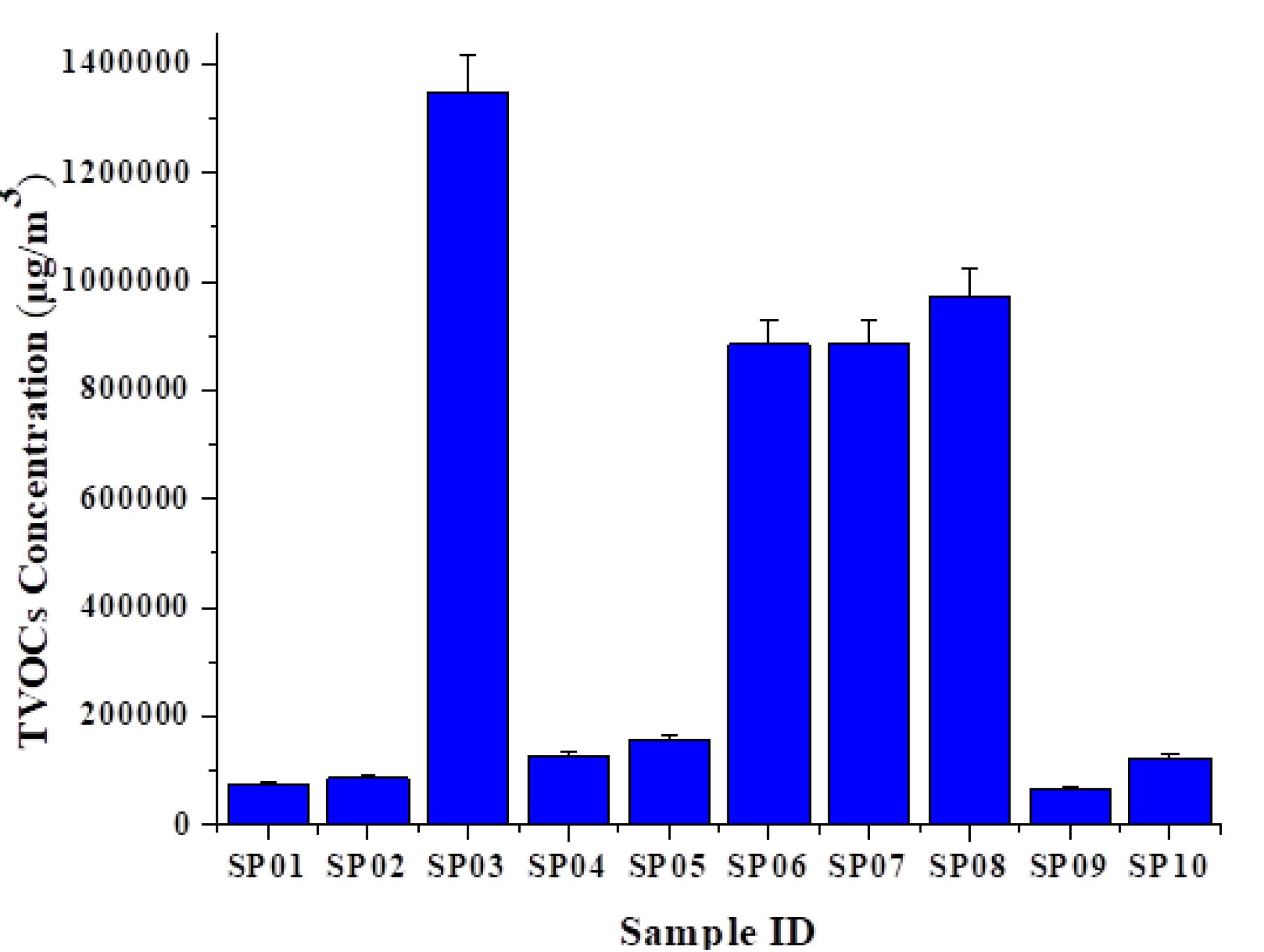
Fig. 2.
1-hour Mean TVOC Concentration in an Indoor Environment
.
1-hour Mean TVOC Concentration in an Indoor Environment
This study investigated only one of the products (hair spray products) used in beauty salons. The use of these products is characterized by the dispersion of VOCs not only in close proximity to the user but also in the immediate surroundings of the user (58). A worst-case scenario could be triggered if two or more of those products are used simultaneously. The worst-case scenario is used in combination. The results indicate that hair spray products are among the major sources of VOCs in indoor environments, which is consistent with that of consumer products identified in the investigations by van Winkle and Scheff (59) and Lin et al (9). Long-term exposure to these VOCs over time can cause skin irritation, respiratory disorders, reproductive issues, adverse genotoxic effects (60), and even cancer in the individuals occupying areas where the products are often used (61). Therefore, effective control measures such as proper ventilation are needed to reduce the levels of these pollutants in indoor environments.
3.3. Health Risk Assessment
The relative contributions of the three exposure pathways (ingestion, dermal absorption, and inhalation) to the total CDI are elucidated in Fig. 3. The ingestion was the main exposure pathway, accounting for 73.27% and 63.81% of the total CDI in adults and children, respectively, followed by dermal absorption, accounting for 26.67% and 34.14% of the total CDI in adults and children, respectively. On the other hand, inhalation contributed very little to the overall results (0.05%) for both groups. The dermal absorption rate was higher in children than in adults because of their higher surface-area-to-body-weight ratio, but ingestion remains the primary route in both adults and children. These findings underscore the importance of controlling ingestion and dermal exposure to reduce the overall CDI.
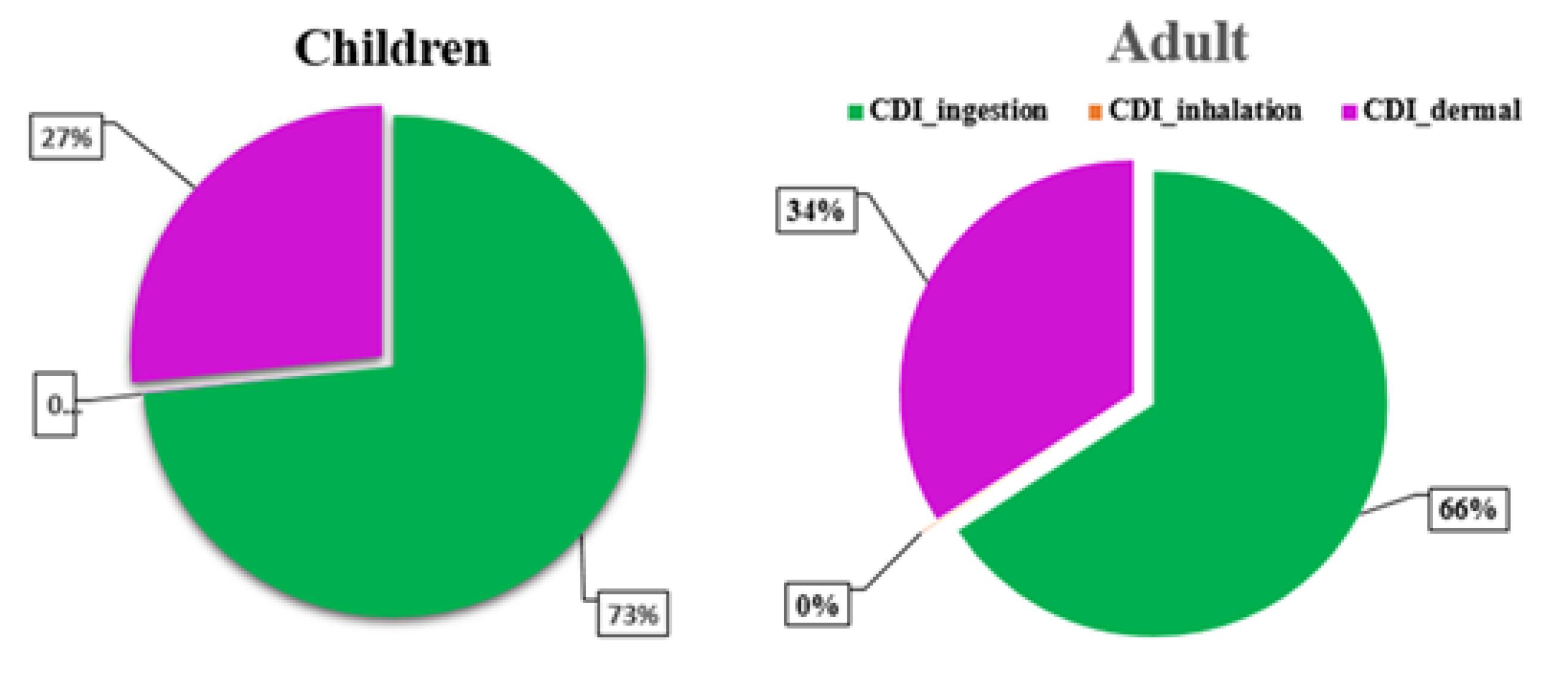
Fig. 3.
Percentage of CDI via Inhalation, Ingestion, and Dermal: in (a) Children and (b) Adults
.
Percentage of CDI via Inhalation, Ingestion, and Dermal: in (a) Children and (b) Adults
The HI due to the exposure to the VOCs emitted from hair spray products was evaluated. The HI ranged from 3.12 × 10⁴ to 6.25 × 10⁴ and 2227.86 to 44590.35 for children and adults, respectively, as shown in Table 3. The difference in the values of these health risk factors can be attributed to variations in the formulation of hair spray products. Higher HI values were obtained for children which could be as a result of higher ingestion rate, higher levels of exposure to environmental contaminants relative to their body size, and their growing organs and immune systems, making children more vulnerable to the damaging effects of toxins and resulting in a higher risk of unfavourable health consequences even at lower exposure levels (62).
Table 3.
Hazard Index of Hair Sprays
|
Sample ID
|
HI
|
|
Children
|
Adults
|
| SP01 |
3.53E + 04 |
2528.93 |
| SP02 |
3.99E + 04 |
2862.07 |
| SP03 |
6.25E + 05 |
44790.35 |
| SP04 |
5.94E + 04 |
4261.01 |
| SP05 |
7.32E + 04 |
5246.02 |
| SP06 |
4.10E + 05 |
29384.33 |
| SP07 |
4.10E + 05 |
29384.33 |
| SP08 |
4.51E + 05 |
32339.37 |
| SP09 |
3.12E + 04 |
2237.86 |
| SP10 |
5.75E + 04 |
4123.77 |
The data and method provided by the USEPA indicate that a HI greater than 1 (HI > 1) represents a high and unacceptable non-carcinogenic risk, while an HI of lower than 1 (HI < 1) indicates an acceptable non-carcinogenic risk. The hazard quotient values obtained in this study were all above 1, indicating a potential risk associated with exposure to VOCs. However, the HI values were lower than what was reported for the health risks associated with exposure to VOCs in beauty salons in other studies (48). This could be due to the synergistic effect of hair sprays and other VOC-rich products commonly used in salons. It can be deduced that people exposed to VOCs tend to be more prone to many health risks. For instance, hairdressers are at high risk of adverse health outcomes due to exposure to hair care products (shampoo, hair sprays, relaxers) (4).
To reduce the risks associated with exposure to VOCs, policymakers such as WHO, National Agency for Food and Drug Administration and Control, and National Environmental Standards and Regulations Enforcement Agency should enforce stricter regulations on ingredient disclosure and statutory limit for VOCs, ensuring that they follow safety standards. Manufacturers should be encouraged to formulate alternatives with low TVOC concentrations, and public health campaigns should be carried out to create awareness among consumers and salon workers about protective measures and proper ventilation. Additionally, improved ventilation guidelines should be provided for salons and further research should be carried out on long-term exposure effects are essential. However, due to the unavailability of reference dose data for human exposure to emitted VOCs through ingestion and dermal pathways, this study focused solely on inhalation risks, highlighting the need for comprehensive data collection to enable a more holistic health risk assessment in the future.
4. Conclusion
The TVOC concentration in popular hair spray products used in Nigeria was assessed in this study. The TVOC concentrations ranged between 67 400 and 1 349 000 µg/m³, exceeding the statutory limits set by regulatory bodies such as NESREA and USEPA. Ingestion had the highest contribution to CDI (73.27% for adults and 63.81% for children) when compared to inhalation and ingestion. The mean values of hazard index for all exposure pathways were above accepted levels for both children and adults. Findings from this study offer valuable insights about the risks associated with using hair spray products, particularly in frequent users and those with respiratory issues. Effective measures such as replacing hair spray products with water-based products with fewer VOCs and proper ventilation should be ensured to reduce the concentration of VOCs in indoor environments. Regulatory bodies can use these results to create an awareness of the exposure levels and effects of the pollutants on users.
Acknowledgements
The authors would like to express their gratitude to the Petroleum Development Trust Fund for the financial support and all those who have contributed to this research paper.
Competing Interests
The authors declare that they have no known competing financial interests or personal relationships that could have appeared to influence the work reported in this paper.
Data Availability Statement
The data generated in this study are available on request.
Ethical Approval
Not applicable.
Funding
This research was supported by the Petroleum Trust Development Fund (PTDF) through a scholarship award (Ref: PTDF/ED/ISS/PHD/ASA/1920/21).
References
- Uter W, Strahwald J, Hallmann S, Johansen JD, Havmose MS, Kezic S. Systematic review on skin adverse effects of important hazardous hair cosmetic ingredients with a focus on hairdressers. Contact Dermatitis 2023; 88(2):93-108. doi: 10.1111/cod.14236 [Crossref] [ Google Scholar]
- Adeniran JA, Yusuf RO, Mustapha SI, Sonibare JA. Exposure to total volatile organic compounds (TVOCs) from household spray products. Environ Res Eng Manag 2017; 73(4):21-30. doi: 10.5755/j01.erem.73.4.19316 [Crossref] [ Google Scholar]
- Solórzano-García LA, Hernández-Paniagua IY, Andraca-Ayala GL, Ruiz-Suárez LG. A simple and robust method for the comprehensive analysis of VOCs in liquid household products. Atmos Pollut Res 2025; 16(2):102378. doi: 10.1016/j.apr.2024.102378 [Crossref] [ Google Scholar]
- Asani MA, Idi MD, Oke IA. Experimental investigation of outdoor air quality at a tertiary institution gate. J Eng Eng Technol 2022; 16(2):58-72. doi: 10.51459/futajeet2022.16.2.343 [Crossref] [ Google Scholar]
- Chen P, Liu W, Nie L, Du Z, Gao M. Characteristics, ozone and SOA formation potentials and health risk assessment of VOCs in hair cosmetic products (HCPs) in Beijing. Environment Int 2021; 154:106655. [ Google Scholar]
- Hao R, Sun J, Liu R, Zhao H, Yao Z, Wang H. Emission characteristics, environmental impact, and health risk assessment of volatile organic compounds (VOCs) during manicure processes. Sci Total Environ 2024; 906:167464. doi: 10.1016/j.scitotenv.2023.167464 [Crossref] [ Google Scholar]
- Zhu L, Shen D, Luo KH. A critical review on VOCs adsorption by different porous materials: species, mechanisms and modification methods. J Hazard Mater 2020; 389:122102. doi: 10.1016/j.jhazmat.2020.122102 [Crossref] [ Google Scholar]
- Wang B, Liu Z, Li Z, Sun Y, Wang C, Zhu C. Characteristics, chemical transformation and source apportionment of volatile organic compounds (VOCs) during wintertime at a suburban site in a provincial capital city, east China. Atmos Environ 2023; 298:119621. doi: 10.1016/j.atmosenv.2023.119621 [Crossref] [ Google Scholar]
- Lin KH, Tsai JH, Cheng CC, Chiang HL. Emission of volatile organic compounds from consumer products Aerosol Air Qual. Res 2022; 22(9):220250. doi: 10.4209/aaqr.220250 [Crossref] [ Google Scholar]
- Zhang J, Bian L, Dong F, Zeng Y, Nie J, Lv Z. Mineralogy and phase transition mechanisms of atmospheric mineral particles: migration paths, sources, and volatile organic compounds. Environ Pollut 2023; 330:121789. doi: 10.1016/j.envpol.2023.121789 [Crossref] [ Google Scholar]
- Embiale A, Zewge F, Chandravanshi BS, Sahle-Demessie E. Short-term exposure assessment to particulate matter and total volatile organic compounds in indoor air during cooking Ethiopian sauces (Wot) using electricity, kerosene and charcoal fuels. Indoor Built Environ 2019; 28(8):1140-54. doi: 10.1177/1420326x19836453 [Crossref] [ Google Scholar]
- Pagonis D, Price DJ, Algrim LB, Day DA, Handschy AV, Stark H. Time-resolved measurements of indoor chemical emissions, deposition, and reactions in a university art museum. Environ Sci Technol 2019; 53(9):4794-802. doi: 10.1021/acs.est.9b00276 [Crossref] [ Google Scholar]
- Katsoyiannis A, Leva P, Kotzias D. VOC and carbonyl emissions from carpets: a comparative study using four types of environmental chambers. J Hazard Mater 2008; 152(2):669-76. doi: 10.1016/j.jhazmat.2007.07.058 [Crossref] [ Google Scholar]
- Dinh TV, Kim SY, Son YS, Choi IY, Park SR, Sunwoo Y. Emission characteristics of VOCs emitted from consumer and commercial products and their ozone formation potential. Environ Sci Pollut Res Int 2015; 22(12):9345-55. doi: 10.1007/s11356-015-4092-8 [Crossref] [ Google Scholar]
- Choi YH, Kim HJ, Sohn JR, Seo JH. Occupational exposure to VOCs and carbonyl compounds in beauty salons and health risks associated with it in South Korea. Ecotoxicol Environ Saf 2023; 256:114873. doi: 10.1016/j.ecoenv.2023.114873 [Crossref] [ Google Scholar]
- Sørli JB, Sengupta S, Jensen A, Nikiforov V, Clausen PA, Hougaard KS. Risk assessment of consumer spray products using in vitro lung surfactant function inhibition, exposure modelling and chemical analysis. Food Chem Toxicol 2022; 164:112999. doi: 10.1016/j.fct.2022.112999 [Crossref] [ Google Scholar]
- Hussain M, He YL, Mohamad AA, Tao WQ. A new hybrid algorithm for numerical simulation of VOC emissions using single-layer and multilayer approaches. Numeri Heat Transf B Fundam 2015; 67(3):211-30. [ Google Scholar]
- Guieysse B, Hort C, Platel V, Munoz R, Ondarts M, Revah S. Biological treatment of indoor air for VOC removal: potential and challenges. Biotechnol Adv 2008; 26(5):398-410. doi: 10.1016/j.biotechadv.2008.03.005 [Crossref] [ Google Scholar]
- Huang Y, Ho SS, Lu Y, Niu R, Xu L, Cao J. Removal of indoor volatile organic compounds via photocatalytic oxidation: a short review and prospect. Molecules 2016; 21(1):56. doi: 10.3390/molecules21010056 [Crossref] [ Google Scholar]
- Adeniran JA, Atanda AS. Carbon monoxide formation from total volatile organic compounds from the use of household spray products. J Air Pollut Health 2023; 8(3):361-80. doi: 10.18502/japh.v8i3.13790 [Crossref] [ Google Scholar]
- Joo S, Yesildagli B, Kwon JH, Lee J. Comparative analysis of indoor volatile organic compound levels in an office: impact of occupancy and centrally controlled ventilation. Atmos Environ 2025; 345:121057. doi: 10.1016/j.atmosenv.2025.121057 [Crossref] [ Google Scholar]
- Paciência I, Madureira J, Rufo J, Moreira A, de Oliveira Fernandes E. A systematic review of evidence and implications of spatial and seasonal variations of volatile organic compounds (VOC) in indoor human environments. J Toxicol Environ Health B Crit Rev 2016; 19(2):47-64. doi: 10.1080/10937404.2015.1134371 [Crossref] [ Google Scholar]
- Attia MF, Swasy MI, Ateia M, Alexis F, Whitehead DC. Periodic mesoporous organosilica nanomaterials for rapid capture of VOCs. Chem Commun (Camb) 2020; 56(4):607-10. doi: 10.1039/c9cc09024j [Crossref] [ Google Scholar]
- World Health Organization (WHO). Air Pollution. WHO; 2021. Available from: https://www.who.int/health-topics/air-pollution#tab=tab_1.
- Ahmed K, Asif HM, Afzal T, Khan MA, Younus M, Khurshid U. Green synthesis and characterization of silver nanoparticles through the Piper cubeca ethanolic extract and their enzyme inhibitory activities. Frontiers in Chemistry 2023; 11:1065986. [ Google Scholar]
- Norouzian Baghani A, Rostami R, Arfaeinia H, Hazrati S, Fazlzadeh M, Delikhoon M. BTEX in indoor air of beauty salons: Risk assessment, levels and factors influencing their concentrations. Ecotoxicol Environ Saf 2018; 159:102-8. doi: 10.1016/j.ecoenv.2018.04.044 [Crossref] [ Google Scholar]
- Salehpour S, Amani R, Nili-Ahmadabadi A. Volatile organic compounds as a preventive health challenge in the petrochemical industries. Int J Prev Med 2019; 10:194. doi: 10.4103/ijpvm.IJPVM_495_18 [Crossref] [ Google Scholar]
- Chang CJ, Cheng SF, Chang PT, Tsai SW. Indoor air quality in hairdressing salons in Taipei. Indoor Air 2018; 28(1):173-80. doi: 10.1111/ina.12412 [Crossref] [ Google Scholar]
- Kaikiti C, Stylianou M, Agapiou A. TD-GC/MS analysis of indoor air pollutants (VOCs, PM) in hair salons. Chemosphere 2022; 294:133691. doi: 10.1016/j.chemosphere.2022.133691 [Crossref] [ Google Scholar]
- Asif Z, Chen Z, Haghighat F, Nasiri F, Dong J. Estimation of anthropogenic VOCs emission based on volatile chemical products: a Canadian perspective. Environ Manage 2023; 71(4):685-703. doi: 10.1007/s00267-022-01732-6 [Crossref] [ Google Scholar]
- Cheng Z, Li B, Yu W, Wang H, Zhang T, Xiong J. Risk assessment of inhalation exposure to VOCs in dwellings in Chongqing, China. Toxicol Res (Camb) 2018; 7(1):59-72. doi: 10.1039/c7tx00191f [Crossref] [ Google Scholar]
- Lazarov B. Characterisation of Flame Retardant Emissions from Treated Consumer and Building Products in Laboratory Conditions and Real-Life Indoor Environments [dissertation]. University of Antwerp; 2022.
- Ji, W., Wang, Y., Zhao, B., & Liu, J. (2024). Identifying high-risk volatile organic compounds in residences of Chinese megacities: A comprehensive health-risk assessment. Journal of Hazardous Materials, 479, 135630.
- Zhu L, Shena D, Luo K. A critical review on VOCs adsorption by different porous materials: Species, mechanisms and modification methods Journal of Hazardous Materials 2020;389(122102):1-23.
- Adeniran JA, Sonibare JA, Jimoda LA. Statistical approach for determining the effects of microclimatic parameters on household spray products aerosol deposition. Atmos Pollut Res 2015; 6(1):21-8. doi: 10.5094/apr.2015.003 [Crossref] [ Google Scholar]
- Adeniran JA, Yusuf RO, Oke EO. Deposition and coagulation of aerosols from household spray products. Songklanakarin J Sci Technol 2019; 41(1):207-15. doi: 10.14456/sjst-psu.2019.25 [Crossref] [ Google Scholar]
- Kim T, Park J, Seo J, Yoon H, Lee B, Lim H. Behavioral characteristics to airborne particles generated from commercial spray products. Environ Int 2020; 140:105747. doi: 10.1016/j.envint.2020.105747 [Crossref] [ Google Scholar]
- López A, Coscollà C, Hernández CS, Pardo O, Yusà V. Dioxins and dioxin-like PCBs in the ambient air of the Valencian region (Spain): levels, human exposure, and risk assessment. Chemosphere 2021; 267:128902. doi: 10.1016/j.chemosphere.2020.128902 [Crossref] [ Google Scholar]
- United States Environmental Protection Agency (USEPA). Risk Assessment Guidance for Superfund (RAGS) Volume III–Part A: Process for Conducting Probabilistic Risk Assessment. Washington, DC: USEPA; 2001.
- Makokha VA, Ndung’u AW, Mungai TM, Yan X, Wang J. Concentrations, sources, and risk assessment of organohalogen compounds in soils from Kiambu to Mombasa, Kenya. Bull Environ Contam Toxicol 2018; 101(6):766-72. doi: 10.1007/s00128-018-2470-x [Crossref] [ Google Scholar]
- Ali N. Polycyclic aromatic hydrocarbons (PAHs) in indoor air and dust samples of different Saudi microenvironments; health and carcinogenic risk assessment for the general population. Sci Total Environ 2019; 696:133995. doi: 10.1016/j.scitotenv.2019.133995 [Crossref] [ Google Scholar]
- Khajeh Hoseini L, Jalilzadeh Yengejeh R, Mohammadi Rouzbehani M, Sabzalipour S. Health risk assessment of volatile organic compounds (VOCs) in a refinery in the southwest of Iran using SQRA method. Front Public Health 2022; 10:978354. doi: 10.3389/fpubh.2022.978354 [Crossref] [ Google Scholar]
- United States Environmental Protection Agency (USEPA). Exposure Factors Handbook: 2011 Edition. Washington, DC: Office of Research and Development, USEPA; 2011. Available from: http://www.epa.gov/ncea/efh/pdfs/efh-complete.pdf.
- Latif M, Nasim I, Ahmad M, Nawaz R, Tahir A, Irshad MA. Human health risk assessment of drinking water using heavy metal pollution index: a GIS-based investigation in mega city. Appl Water Sci 2024; 15(1):12. doi: 10.1007/s13201-024-02341-w [Crossref] [ Google Scholar]
- Rostami R, Zarei A, Saranjam B, Ghaffari HR, Hazrati S, Poureshg Y. Exposure and risk assessment of PAHs in indoor air of waterpipe cafés in Ardebil, Iran. Build Environ 2019; 155:47-57. doi: 10.1016/j.buildenv.2019.03.031 [Crossref] [ Google Scholar]
- Yusuf RO, Odediran ET, Adeniran JA, Adesina OA. Polycyclic aromatic hydrocarbons in road dusts of a densely populated African city: spatial and seasonal distribution, source, and risk assessment. Environ Sci Pollut Res Int 2022; 29(29):44970-85. doi: 10.1007/s11356-022-18943-3 [Crossref] [ Google Scholar]
- Kumar B, Verma VK, Kumar S, Sharma CS. Probabilistic health risk assessment of polycyclic aromatic hydrocarbons and polychlorinated biphenyls in urban soils from a tropical city of India. J Environ Sci Health A Tox Hazard Subst Environ Eng 2013; 48(10):1253-63. doi: 10.1080/10934529.2013.776894 [Crossref] [ Google Scholar]
- Senthong P, Wittayasilp S. Working conditions and health risk assessment in hair salons. Environ Health Insights 2021; 15:11786302211026772. doi: 10.1177/11786302211026772 [Crossref] [ Google Scholar]
- Soltani N, Keshavarzi B, Moore F, Tavakol T, Lahijanzadeh AR, Jaafarzadeh N. Ecological and human health hazards of heavy metals and polycyclic aromatic hydrocarbons (PAHs) in road dust of Isfahan metropolis, Iran. Sci Total Environ 2015; 505:712-23. doi: 10.1016/j.scitotenv.2014.09.097 [Crossref] [ Google Scholar]
- Peng C, Chen W, Liao X, Wang M, Ouyang Z, Jiao W. Polycyclic aromatic hydrocarbons in urban soils of Beijing: status, sources, distribution and potential risk. Environ Pollut 2011; 159(3):802-8. doi: 10.1016/j.envpol.2010.11.003 [Crossref] [ Google Scholar]
- Zhou L, Liu G, Shen M, Hu R, Sun M, Liu Y. Characteristics and health risk assessment of heavy metals in indoor dust from different functional areas in Hefei, China. Environ Pollut 2019; 251:839-49. doi: 10.1016/j.envpol.2019.05.058 [Crossref] [ Google Scholar]
- Odediran ET, Adeniran JA, Yusuf RO, Abdulraheem KA, Adesina OA, Sonibare JA. Contamination levels, health risks and source apportionment of potentially toxic elements in road dusts of a densely populated African city. Environ Nanotechnol Monit Manag 2021; 15:100445. doi: 10.1016/j.enmm.2021.100445 [Crossref] [ Google Scholar]
- Abdulraheem MO, Adeniran JA, Ameen HA, Odediran ET, Yusuf MO, Abdulraheem KA. Source identification and health risk assessments of heavy metals in indoor dusts of Ilorin, north- central Nigeria. J Environ Health Sci Eng 2022; 20(1):315-30. doi: 10.1007/s40201-021-00778-8 [Crossref] [ Google Scholar]
- World Health Organization (WHO). WHO Guidelines for Indoor Air Quality: Selected Pollutants. WHO Regional Office for Europe; 2010.
- Hao R, Lin X, Yao Z, Wang M, Sun J, Wang H. Emission characteristics, environmental impact, and occupational health risks assessment of volatile organic compounds (VOCs) in the hairdressing sector. Atmos Pollut Res 2025; 16(5):102471. doi: 10.1016/j.apr.2025.102471 [Crossref] [ Google Scholar]
- Rahman MM, Kim K-H. Potential hazard of volatile organic compounds contained in household spray products. Atmos Environ 2014; 85:266-74. doi: 10.1016/j.atmosenv.2013.12.001 [Crossref] [ Google Scholar]
- Gao M, Liu W, An X, Nie L, Du Z, Chen P. Emission factors and emission inventory of volatile organic compounds (VOCs) from hair products application in hair salons in Beijing through measurement. Sci Total Environ 2023; 878:162996. doi: 10.1016/j.scitotenv.2023.162996 [Crossref] [ Google Scholar]
- Lee M, Oh G, Kwon T, Park J, Lee K, Zoh KD. Emission characteristics of volatile organic compounds from consumer spray products based on product type, spray method, and distance. Sci Rep 2024; 14(1):17041. doi: 10.1038/s41598-024-67963-1 [Crossref] [ Google Scholar]
- van Winkle MR, Scheff PA. Volatile organic compounds, polycyclic aromatic hydrocarbons and elements in the air of ten urban homes. Indoor Air 2001; 11(1):49-64. doi: 10.1034/j.1600-0668.2001.011001049.x [Crossref] [ Google Scholar]
- Hadei M, Hopke PK, Shahsavani A, Moradi M, Yarahmadi M, Emam B. Indoor concentrations of VOCs in beauty salons; association with cosmetic practices and health risk assessment. J Occup Med Toxicol 2018; 13:30. doi: 10.1186/s12995-018-0213-x [Crossref] [ Google Scholar]
- Guo H, Lee SC, Chan LY, Li WM. Risk assessment of exposureto volatile organic compounds in different indoor environments. Environ Res 2004; 94(1):57-66. doi: 10.1016/s0013-9351(03)00035-5 [Crossref] [ Google Scholar]
- Atanda AS, Adeniran JA, Adewoye L. Polychlorinated biphenyl levels and associated health risks in indoor atmosphere of beauty salons. Niger J Technol Dev 2024; 21(3):39-51. doi: 10.4314/njtd.v21i3.2587 [Crossref] [ Google Scholar]